
The Medical Futurist – Read More
AI has been part of the conversation in healthcare for over a decade, but something has clearly changed. What used to be a promise about the future is now part of everyday clinical reality. AI is already present in how we document, analyze data, and support decision-making. Yet, despite all the headlines and excitement, most medical professionals are still left with a simple and very practical question: what should I actually do with it?
The rapid rise of generative AI and large language models has accelerated this shift. With hundreds of millions of users and massive investments from both technology companies and healthcare institutions, AI has become the ultimate conversation starter in medicine. Questions such as whether AI will replace physicians, diagnose patients, or reshape the economics of healthcare are everywhere. However, these questions often remain abstract and do not help clinicians make better decisions in their daily work.
At the same time, it is not flawless. It can produce misleading outputs, introduce bias, or lead to over-reliance if used incorrectly. This makes it essential to approach AI with the same mindset as any other medical tool: grounded in evidence, aware of limitations, and focused on patient benefit.
This is why we launched a fast-track course: AI Survival Kit For Medical Professionals!
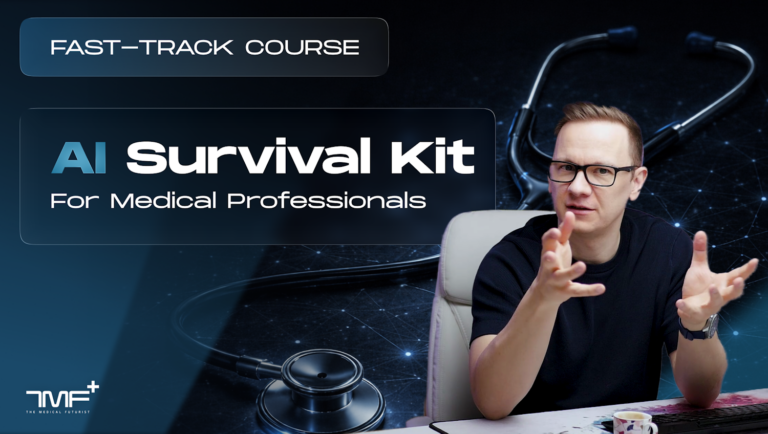
About the course
The goal of the course is to cut through the noise and focus on what actually works today. It is a practical, no-hype guide to using AI in everyday clinical work, showing:
- what AI tools you can safely use now
- what you should never delegate to AI
- how to stay in control as a physician
- how to communicate about AI with patients
- how to prepare your career for the changes ahead
The course is built around real-world examples and actionable frameworks. It covers areas such as AI-supported documentation, including the use of AI scribes, clinical decision support, patient communication, and prompt engineering. It also addresses critical topics such as evaluating AI tools, understanding their limitations, and maintaining clinical responsibility.
The curriculum is structured into four main chapters:
- Chapter 1 introduces the course and provides a reality check about the current state of AI in healthcare
- Chapter 2 explores where AI stands today, including case studies, opportunities, risks, and advantages
- Chapter 3 serves as a practical guide to using AI tools, from generative AI and large language models to AI scribes
- Chapter 4 focuses on how your career can be augmented by AI
- Bonus chapter offers additional insights and resources
This course is designed for medical professionals who want practical guidance on how to navigate AI in their daily work, stay relevant, and make informed decisions about using or evaluating AI tools. You do not need any technical background. The focus is on clarity, confidence, and safe application.
The course is designed as a fast-track program and can be completed in just 1–3 hours, making it easy to fit into even the busiest clinical schedule. You can go through it in one sitting or break it into shorter sessions over a few days.
A certificate of completion is provided to students who successfully finish the course. The certificate can be downloaded from the course platform and can serve as evidence of your understanding and knowledge in the field of artificial intelligence in medicine and healthcare.
AI will not replace physicians, but it will change what it means to be one. Those who ignore it risk falling behind, while those who learn how to use it thoughtfully can shape how it is implemented in healthcare.
Check it out to find out how to bring AI into your clinical work today!
The post New Course: AI Survival Kit For Medical Professionals appeared first on The Medical Futurist.