
MedTech Intelligence – Read More
Adoption Is Not Governance
Artificial intelligence is already inside regulatory affairs functions across the medtech industry. Teams are using it to summarize guidance documents, support first-pass drafting, compare labeling versions, and triage incoming intelligence. In many organizations, this happened quietly as individuals found tools that helped them move faster, and adoption outpaced the policies meant to govern it. Shadow AI is the practical name for what this looks like in the field. A team member under deadline pressure opens a public AI tool and drafts a deficiency response. The output is polished and reads like regulatory writing. It moves through review without anyone noting the tool, the prompt, the version, or the verification step. Nothing went wrong this time. But there is no record that would let the organization explain what happened if something had.
Regulatory affairs is not a function where plausible-looking output is good enough. When AI influences a submission, a deficiency response, a labeling discussion, or a change assessment, three questions have to be answerable: What tool was used? How was the output verified? Who was accountable for it? Right now, most organizations cannot answer all three consistently. The question is not whether AI can accelerate regulatory work because most experienced professionals would agree it can. The question is whether the organization has developed the governance to match its adoption.
A Practical Way to Assess Where You Stand
The Operational AI Capability Maturity Model for Regulatory Affairs offers a five-level framework: Unstructured, Defined, Controlled, Governed, and Optimized that any medtech organization can use to evaluate where current practice stands and what needs to develop next5 as seen in Fiugure 1. The levels are not aspirational milestones, they are a diagnostic. The goal is not to reach “Optimized” level. It is to know accurately where the organization is today and what the most consequential next step looks like from there.
Figure 1: Regulatory AI Capability Maturity Model
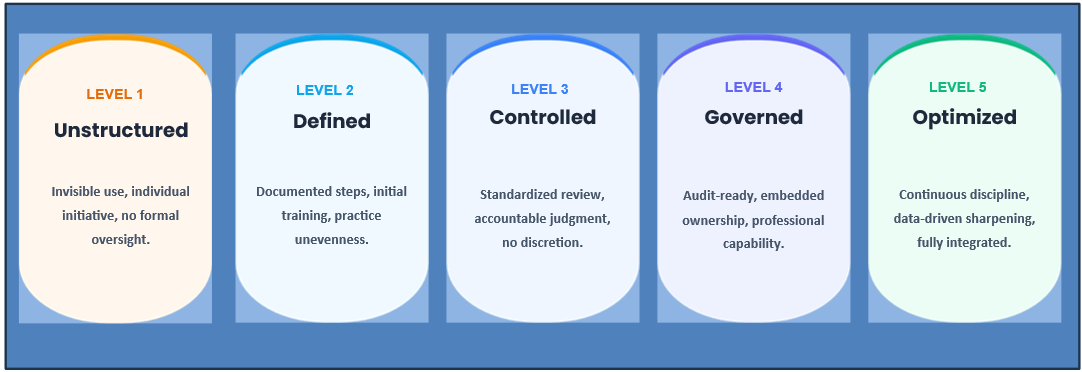
Table 1 summarizes what each level looks like in practice and what it looks like in a medtech RA function. One thing to remember is that these levels describe the organization, not the tool. A team running a sophisticated AI platform with no documented use cases and no review standard is still Unstructured. The capability of the tool is not the same thing as the maturity of the organization using it.
Table 1: The Operational AI Capability Maturity Model for Regulatory Affairs
| Level | What It Means | What It Looks Like in a Medtech RA Function | The Core Risk |
| Unstructured | AI use is informal and invisible to the organization. No approved use cases, no data handling rules, no review expectations, no distinction between enterprise and public tools. | A specialist uses a public LLM to draft a response to a competent authority question or summarize an MDCG guidance document. No rules exist on what may be entered, how output should be verified, or whether anything gets retained. | Factual errors, data exposure, and no defensible review trail |
| Defined | Initial use cases are identified and basic guidance is beginning to take shape; but practice is uneven and risk is not yet differentiated by task. | Teams use AI comfortably for meeting summaries and literature triage, but the same informal approach extends to first-pass drafting of deficiency responses, tasks that carry very different compliance consequences. | High-risk tasks handled with the same informality as low-risk ones |
| Controlled | Approved and prohibited uses are documented. Role-based training is in place. Review expectations are standardized and no longer left to individual judgment. | Staff understand that summarizing a public guidance document does not require the same review rigor as drafting a response to an FDA deficiency question. Enterprise-approved tools are required for regulated content; documentation standards are emerging. | AI output may still not be consistently tracked when it influences regulated content |
| Governed | AI use is embedded in the regulatory operating model. Ownership is clear, escalation paths are defined, and use-case approval is linked to risk level. Cross-functional alignment with quality, IT, legal, and privacy is in place. | AI-supported workflows for submission support, labeling review, and authority correspondence are formally approved. The organization knows which outputs stay in working files, which require retention, and which need additional approval before influencing a regulatory position. | Governance exists on paper but may not yet reflect how tools are actually used day to day |
| Optimized | AI governance is treated as a continuous operational discipline — use cases are reviewed as tools evolve, training is updated, and exceptions are monitored and learned from. | Regulatory affairs is no longer reacting to AI adoption, it is actively shaping it. The question is no longer “Are we allowing AI?” but “Under what conditions does AI use improve regulatory work without weakening accountability?” | Primary challenge is sustaining the discipline over time |
Measure What Matters
The maturity model is assessed across five domains — People, Process, Technology, Oversight, and Evidence Management — because governance rarely fails uniformly. A regulatory team can have access to a secure, enterprise-approved AI platform and still have no shared understanding of what “reviewed output” actually means. That is a People gap showing up inside a Technology-mature environment, and a single overall maturity score would never surface it.
Each domain has a specific focus:
- People — Do users understand what the tools can and cannot do? Do reviewers know how to verify AI output? Is anyone formally accountable for AI governance in the RA function?
- Process — Are approved and prohibited use cases documented? Is review a standard step, or a personal choice? Do exceptions follow a defined path?
- Technology — Are tools selected and approved for the intended regulatory use? Is access controlled? Can outputs be traced back to a session or version?
- Oversight — Is there a named reviewer for higher-risk AI-supported outputs? Are escalation paths clear when output quality is uncertain?
- Evidence Management — Can the organization explain how AI-supported output was used, how it was checked, and whether it should be retained as part of the working or regulated record?
A few direct questions per domain tend to be more revealing than any formal audit. If those questions are hard to answer, the maturity level answers itself.
Why This Matters Right Now
Regulatory guidance has been moving in a consistent direction. FDA’s draft guidance on AI in regulatory decision-making emphasizes intended use, output risk, and credibility evidence before reliance.¹ The EU AI Act reinforces lifecycle accountability and human oversight in higher-consequence settings.² None of this is new philosophy as it is familiar regulatory logic, now being stated explicitly in the context of AI. NIST’s AI Risk Management Framework adds proportionate governance, traceability, and human oversight as foundational requirements. ⁴ These principles: intended use, risk proportionality, human oversight, traceability are already deeply familiar to regulatory professionals. The maturity model brings them into the internal operating context where AI is now routinely being used.
The stakes became concrete in April 2026, when FDA issued a warning letter containing a section headed “Inappropriate Use of Artificial Intelligence in Pharmaceutical Manufacturing” a designation that had not previously appeared in agency enforcement correspondence.³ The manufacturer had used an AI agent to generate SOPs, specifications, and production records without adequate human review. When investigators found that process validation had not been conducted prior to distribution, the owner replied that the AI tool had never flagged the requirement. The facility was pharmaceutical, not medical device. The principle is identical: AI does not carry regulatory accountability, people do.
Moving From Assessment to Action
The most productive starting point is a structured self-assessment across the five domains one honest question per domain, answered cross-functionally. Are approved use cases documented? Is there a named reviewer for AI-assisted regulatory content? Can the organization explain what happened when AI informed a regulated decision?
The maturity model is only useful if it drives action. Organizations do not need to reach the highest level to benefit, they need only to know where they currently stand and what the next reasonable step looks like. A domain-mapped readiness checklist with criteria for each maturity level serves as the practical companion to this framework. Most organizations, when they work through it, find the gap is not where they expected.
Conclusion
The challenge facing medtech regulatory affairs is no longer whether AI will be used internally. It already is. The more important question is whether organizations can operationalize that use in a way that is disciplined, proportionate, and consistent with the standards of evidence and accountability that regulatory work demands.
A useful test inspired by the risk-based thinking already familiar to regulatory professionals is whether your organization can answer three questions for any AI-assisted regulatory task:
- What are the possible consequences if the AI output is wrong?
- What level of human review is required to manage that risk?
- Who is accountable for the final work product?
If the answer is no, your organization may have AI adoption but not yet AI governance. The difference between those two outcomes is not the tool. It is the maturity of the organization using it.
References
- S. Food and Drug Administration. Considerations for the use of artificial intelligence to support regulatory decision-making for drug and biological products. Draft Guidance. January 2025. Available at: https://www.fda.gov/regulatory-information/search-fda-guidance-documents/considerations-use-artificial-intelligence-support-regulatory-decision-making-drug-and-biological
- European Parliament and Council of the European Union. Regulation (EU) 2024/1689 — Artificial Intelligence Act. Official Journal of the European Union. June 2024. https://eur-lex.europa.eu/eli/reg/2024/1689/oj/eng
- S. Food and Drug Administration. Warning Letter to Purolea Cosmetics Lab (MARCS-CMS 722591). Issued April 2, 2026. Available at: https://www.fda.gov/inspections-compliance-enforcement-and-criminal-investigations/warning-letters/purolea-cosmetics-lab-722591-04022026
- National Institute of Standards and Technology. Artificial intelligence risk management framework: Generative artificial intelligence profile (NIST AI 600-1). July 2024. https://www.nist.gov/itl/ai-risk-management-framework
- Hussein, R., Zink, A., Ramadan, B., Howard, F. M., Hightower, M., Shah, S., et al. (2026). Advancing healthcare AI governance through a comprehensive maturity model based on systematic review. *npj Digital Medicine*, 9(1). https://doi.org/10.1038/s41746-026-02418-7. https://www.nature.com/articles/s41746-026-02418-7_reference.pdf
The post Is Your Organization Ready to Govern AI in Regulatory Affairs? appeared first on MedTech Intelligence.