TIME – Read More
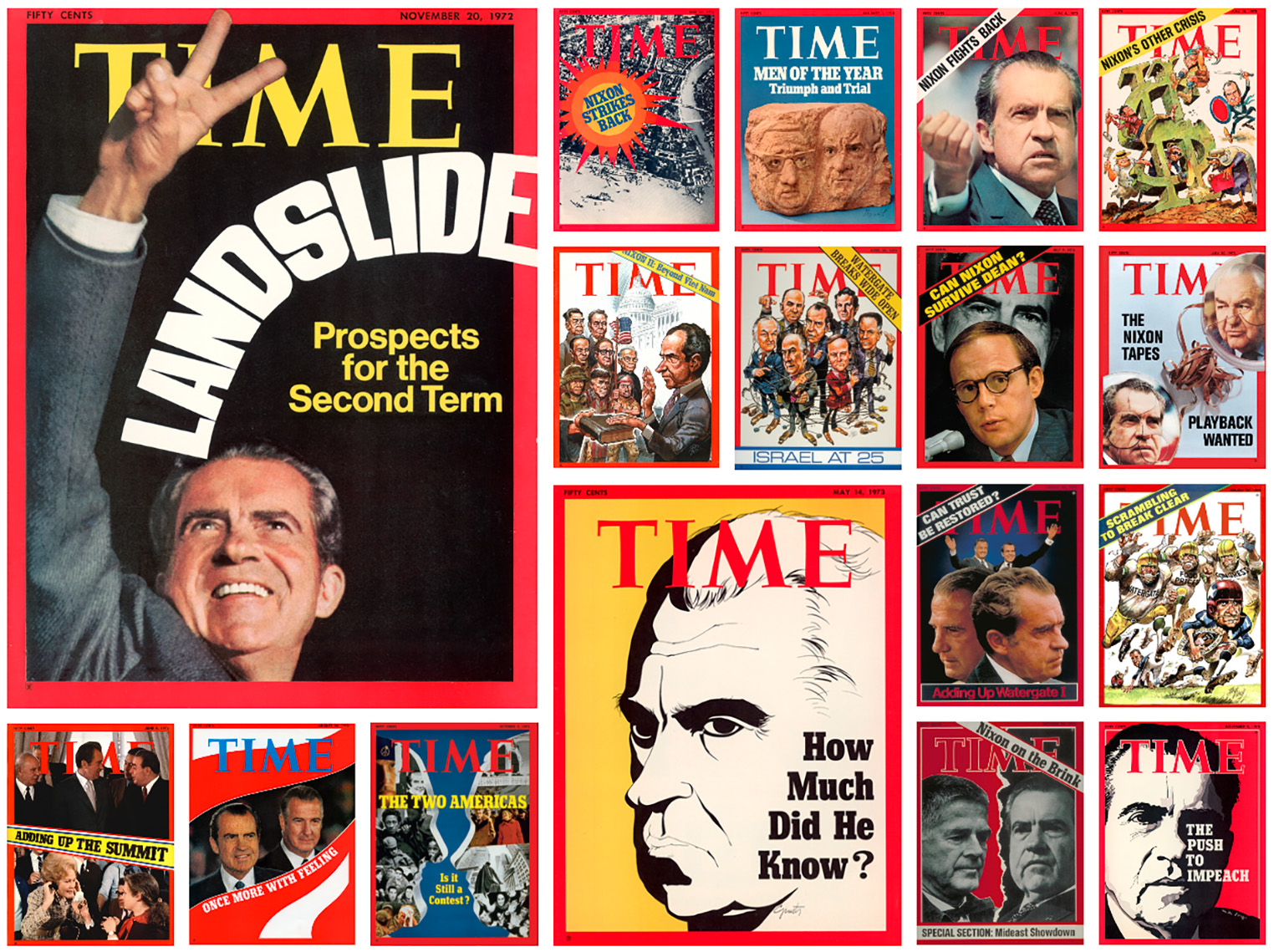
Berating reporters, revoking credentials, suing news organizations—hardly a week goes by without Donald Trump’s attacking the press. An experienced commander of headlines and inveterate consumer of media, he cajoles journalists one day and harangues them the next. But the man who preceded Trump as the President to appear most often on the cover of TIME reigned supreme in media manipulation too. Well before Trump railed against fake news, Richard Nixon waged a sustained campaign to intimidate and punish those who covered him.
Read more: How Donald Trump Has Appeared on the Cover of TIME More Than Anyone Else
The relationship between Presidents and the press is inherently adversarial. Since the emergence of a modern mass media and a professional White House press corps in the early 20th century, Presidents have sought to use journalists to disseminate their ideas, goals, and achievements—and have treated coverage that deviates from their spin as misleading, hostile, or malicious. Reporters, on the other hand, while recognizing their duty to relay what the President says and does, believe that they can offer a fuller, more accurate account of events than the White House does—by adding context, checking facts, and airing dissenting views. In that difference of perspective lies a recipe for conflict.
Every President has warred with journalists. Theodore Roosevelt sued Joseph Pulitzer’s New York World for alleging corruption in the purchase of the Panama Canal. (He lost.) Franklin Roosevelt instructed an impertinent correspondent to don a dunce cap and stand in the corner. Dwight Eisenhower baldly lied to the press after the Soviet Union shot down an American spy plane. Barack Obama tried to exclude Fox News from an interview with the other TV networks and used the Espionage Act to pursue leakers. The list goes on.
But, at least until Trump, no other President had a more contentious relationship with the media than Nixon. By the time he took office in 1969, the White House–press relationship had grown sharply combative, thanks to the Vietnam War, Lyndon Johnson’s “credibility gap,” and the cultural upheavals and suspicion of authority that marked the 1960s. Journalists took it for granted that Nixon, with his long history of resenting the press, had nefarious designs on neutering the Fourth Estate. The venerated CBS anchorman Walter Cronkite labeled Nixon’s antipress campaign “a grand conspiracy.” Washington Post editor Ben Bradlee charged that “the First Amendment is in greater danger than any time I’ve seen it.” A National Press Club report found Nixon guilty of “an unprecedented, government-wide effort to control, restrict and conceal information” and “discredit the press.” And all of this happened before impeachment proceedings even began.
The relationship was not exclusively hostile. As with all administrations, there were ups and downs. At times, even as they distrusted him personally, reporters showered Nixon with admiring coverage, such as during the summer of 1972 when détente was easing tensions with the Soviet Union and after Nixon made his breakthrough trip to communist China. That summer, according to press critic Ben Bagdikian’s count, of more than 2,200 Washington correspondents, only about a dozen pursued the emerging Watergate story. Nixon coasted to re-election.
Yet these bouts of positive coverage did little to appease Nixon, whose antipress campaign continued unabated. Some of the President’s men later owned up to zealotry. “We used to watch the news broadcasts and go up the walls at what we thought was unfair coverage of Nixon,” recalled Chuck Colson, who in the fall of 1972 bullied CBS executives into shortening the second part of a Watergate exposé. Speechwriter Ray Price said flatly, “We did often lie, mislead, deceive, try to use [the press], and to con them.” William Safire, another speechwriter, recalled Nixon insisting that “the press is the enemy … to be hated and beaten”—an attitude Safire called “neither justifiable nor defensible” and yet deeply held.
The particular skirmishes in Nixon’s war on journalists would fill not only a ledger but a shelf of books. (In writing my own book about Nixon, I consumed at least a dozen books on the subject, with titles like The Chilling Effect in TV News: Intimidation by the Nixon White House and The Engineering of Restraint: The Nixon Administration and the Press.) Some of the Administration’s offenses appear in retrospect fairly routine or mild, like the maddening evasiveness of press secretary Ron Ziegler, or even Vice President Spiro Agnew’s baroque diatribes in which he lashed out at the power of the TV networks and major newspapers. But others were genuinely disturbing assaults on the independence of the press corps, waged by a man loath to acknowledge any constraints on his power.
One of the earliest of these was Nixon’s plan, hatched with National Security Adviser Henry Kissinger, to stop leaks by wiretapping the homes and phones of journalists who reported critically on the Administration’s actions, starting with the 1969 bombing of North Vietnamese sanctuaries in Cambodia, which the White House had hoped to keep secret. At the Georgetown home of syndicated columnist Joseph Kraft, another targeted newsman, White House hireling John J. Ragan, wearing a repairman’s uniform, climbed up a nearby telephone pole to install a battery-operated transmitter that would convey every conversation on the Kraft family phone to a tape recorder in the trunk of a car parked close by. The wiretaps on Kraft and other reporters, installed without any warrant, wouldn’t be exposed until just before the 1973 Watergate hearings, but they were later found to be unconstitutional infringements on the journalists’ rights.
The wiretapping scheme grew out of Nixon and Kissinger’s mania for clamping down on leaks that might damage the Administration’s standing. That mania resurfaced in 1971, after the New York Times published the Pentagon Papers, a Defense Department study of American involvement in the Vietnam War. Told by Kissinger that he would be seen as a “weakling” if he didn’t respond, the President had his Attorney General sue the Times to force it to stop publishing the classified documents. No previous Administration had ever tried to impose “prior restraint”—government censorship prohibiting the publication of material before it appears. Eventually, in a landmark First Amendment case, the Supreme Court rejected Nixon’s claim that national security justified the suppression of the information. But the Pentagon Papers leak had other consequences too: it spurred the White House to create the so-called Plumbers unit—plumbers, after all, fix leaks—that would soon engage in a battery of illegal activities, including the break-ins at the Democratic headquarters at the Watergate complex in 1972.
Nixon also used the power of the Executive Branch to punish news outlets he considered unfriendly. The Washington Post Co. at the time owned two Florida television stations, WJXT in Jacksonville and WPLG in Miami, whose licenses were regulated by the Federal Communications Commission. Furious that the Post was digging into Watergate, Nixon fumed to his aides H.R. Haldeman and John Dean in September 1972, “The Post is going to have damnable, damnable problems out of this one. They have a television station … and they’re going to have to get it renewed … the game has to be played awfully rough.” Soon thereafter, allies of Nixon challenged the Post’s ownership of those licenses—challenges that failed but that hurt the company’s stock price and cost it huge legal fees.
Individuals, too, faced retribution. White House correspondent Martin Schram of Newsday, who had reported on Nixon’s dubious financial entanglements with his shady friend Bebe Rebozo, was excluded from the President’s historic 1972 China trip. CBS News’ Daniel Schorr endured an FBI investigation after a negative piece about Nixon’s pledge to help Catholic parochial schools. Nixon often told aides to have the IRS audit his journalistic detractors; some of these enemies were audited, although direct links to the President’s instructions were hard to prove. Nixon and his confidants also discussed taking revenge on syndicated journalist Jack Anderson, a regular thorn in the Administration’s side. G. Gordon Liddy, the resident wild man of Nixon’s re-election team, at one point plotted in all seriousness to have the columnist assassinated, even enlisting a CIA poison expert to help with the planning. Saner heads quashed the plan.
Nixon’s war on the media ultimately failed. The courts rebuffed his attempt to censor the Pentagon Papers. Congress exposed many of his illegal and covert operations. Watergate showed the value of investigative journalism in holding a lawless President accountable. But Watergate also heightened journalists’ propensity to distrust power and embrace a confrontational posture, sometimes manifested in productive reporting but as often evident in a reflexively snide, captious tone. Presidents, meanwhile, if not matching Nixon in their sheer hostility toward the media, followed him in viewing reporters as adversaries to be monitored, punished, and discredited. In that sense, Donald Trump simply inherited a playbook bequeathed by Nixon.