HIT Consultant – Read More
What You Should Know
- Philips secured an award of up to $33.7M from the Advanced Research Projects Agency for Health (ARPA-H) under its Autonomous Interventions and Robotics (AIR) program, led by Dr. Ileana Hancu.
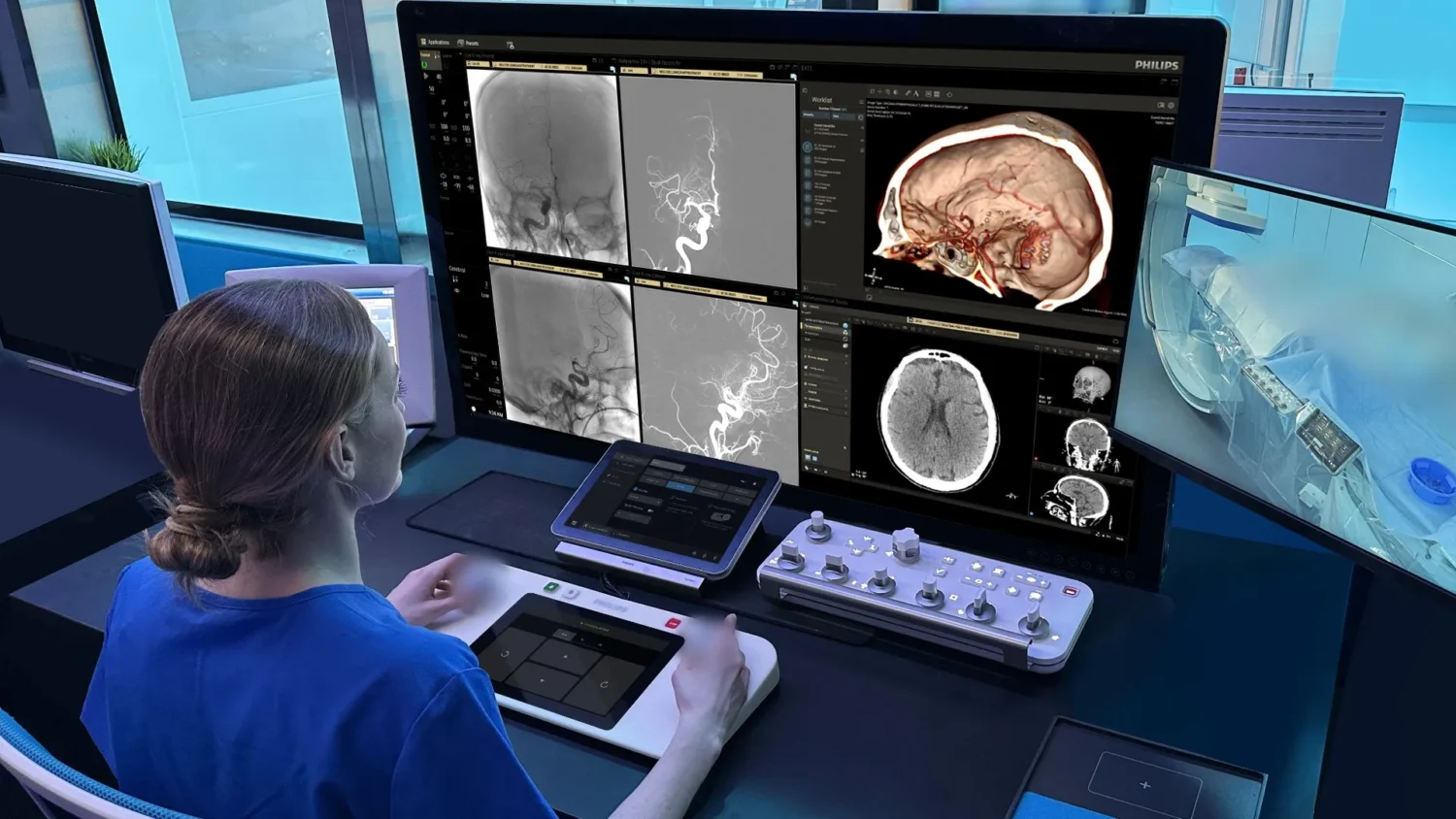
- Develops AI-enabled robotic procedure automation and remote-assisted capabilities for endovascular stroke treatment (mechanical thrombectomy) built on the Philips Azurion image-guided therapy platform.
- The program integrates AI navigation algorithms, robotic catheter control, and real-time imaging guidance into the Philips Azurion image-guided therapy platform to enable remote-assisted and supervised autonomous endovascular interventions.
The Geography Problem in Acute Stroke Intervention
In acute ischemic stroke, “time is brain.” When a large-vessel occlusion cuts off cerebral blood flow, approximately 1.9 million neurons die every minute the vessel remains blocked. Mechanical thrombectomy—a catheter-based procedure that physically navigates the neurovasculature to retrieve the clot—is among the most effective interventions in modern medicine, frequently reversing severe neurological deficits.
However, the procedure suffers from a severe geographic bottleneck. In the United States, approximately 335,000 patients qualify for thrombectomy each year, yet only 12% ever receive it. More than half of the U.S. population lives over an hour from an advanced comprehensive stroke center capable of performing neurointerventional procedures. On a global scale, the disparity is even starker: fewer than 3% of eligible patients with large-vessel occlusions receive mechanical thrombectomy. Because transferring an acute patient to a distant tertiary facility often consumes the critical therapeutic window, thousands of patients are left with permanent disability or die simply due to proximity constraints.
To dismantle these physical barriers, ARPA-H selected Philips to lead an initiative under its Autonomous Interventions and Robotics (AIR) program to engineer remote-assisted, supervised autonomous endovascular surgery.
Azurion Integration, Autonomous Navigation, and Steerable Catheter Engineering
The ARPA-H project unites medical device manufacturing, academic engineering, and clinical neurosurgery to establish supervised robotic autonomy in endovascular therapy:
- Azurion Image-Guided Platform Integration: Embeds endovascular robotics, smart micro-interventional devices, real-time fluoroscopic imaging, and AI workflow orchestration directly into the Philips Azurion architecture, supporting progressive levels of supervised procedural autonomy under expert physician control.
- Autonomous Endovascular Navigation (Johns Hopkins): Led by Axel Krieger, PhD, Associate Professor in Mechanical Engineering at Johns Hopkins University, this development stream focuses on algorithmic path-planning and automated sensorimotor navigation to guide catheters safely through complex arterial vascular trees.
- Advanced Steerable Catheter Development (Boston University): Co-led by Tommaso Ranzani, PhD, and Sheila Russo, PhD, Associate Professors in Mechanical Engineering and Materials Science & Engineering at Boston University, this team is engineering miniaturized, flexible, steerable catheter hardware designed for precise robotic actuation in delicate cerebral vasculature.
- Neurosurgical Translation & Remote Triage (Weill Cornell Medicine): Guided by Dr. J Mocco, Chair of Neurological Surgery at Weill Cornell Medicine, this initiative establishes clinical validation protocols, safety envelopes, and remote-intervention pathways to enable specialists to oversee or perform procedures from distant hubs.
- Global Scale and Public-Private Track Record: Capitalizes on Philips’ installed footprint of over 20,000 image-guided therapy systems operating across more than 80 countries, where a patient is treated every second.
“This ARPA-H program accelerates our long-term vision for image-guided intervention,” said Bert van Meurs, Chief Business Leader Image-Guided Therapy at Philips. “We’re helping shape a future where expert care is no longer limited by geography or workforce constraints. The goal is not to replace expertise, but to make expertise scalable and accessible.”