TIME – Read More
Americans are warming to China, new surveys show.
A Pew Research Center survey published Wednesday found that the share of Americans with a cold view of China has fallen to 54% from 68% in 2021. Over the same period, the share of Americans with a warm view of China grew from 11% to 19%, while those with a neutral view grew from 20% to 27%. The findings are based on responses from 1,168 U.S. adults who were asked to rate China as part of a broader survey conducted Sept. 14-20.
Another survey published this week by the Chicago Council on Global Affairs found that American sentiment towards China has warmed since a record low in 2024. The survey, conducted July 10-21, showed that fewer Americans see China as a threat, with 41% considering China’s territorial ambitions a critical threat to the U.S. as compared to 52% in 2022. Americans also increasingly favor cooperation with China over containment: 57% said the U.S. should engage with China, while 40% think the U.S. should actively limit the growth of China’s power.
“There is appetite for engagement. Part of this may be recognition that better understanding is a positive,” says Ja-Ian Chong, associate professor of political science at the National University of Singapore.
Chong says the results reflect a “rebound” from pandemic-era lows of U.S. views of China. A Pew survey published in July 2020 found that 73% of Americans viewed China unfavorably—then the highest share since Pew began tracking the measure in 2005. By 2023, a separate Pew survey found that figure had risen to 83%, amid widespread concern about Beijing’s relationship with Russia and tensions over Taiwan.
Mixed politics
President Donald Trump has also signaled greater openness to Beijing, at least in its economic relationship. The “positive language coming from the White House” may have fuelled some of the shift, Chong tells TIME.
Early into his second term, Trump raised tariffs on many Chinese imports to a staggering 145% in an effort to bring manufacturing back to the U.S. His Administration also increased scrutiny of Chinese visa applicants and revoked the visas of some Chinese students, raising alarms about a “China Initiative 2.0.” The Administration also restricted sales of Nvidia’s H20 artificial intelligence chip to China and added dozens of Chinese entities to an export blacklist over national security concerns.
The Trump Administration has also continued its crackdown on “birth tourism,” a practice Trump has singled out Chinese nationals over. On Wednesday, the State Department announced that it would restrict visas for foreigners who knowingly participate in or facilitate commercial arrangements to give birth in the U.S. in order to secure their children American citizenship, a policy widely seen as an effort to restrict birthright citizenship.
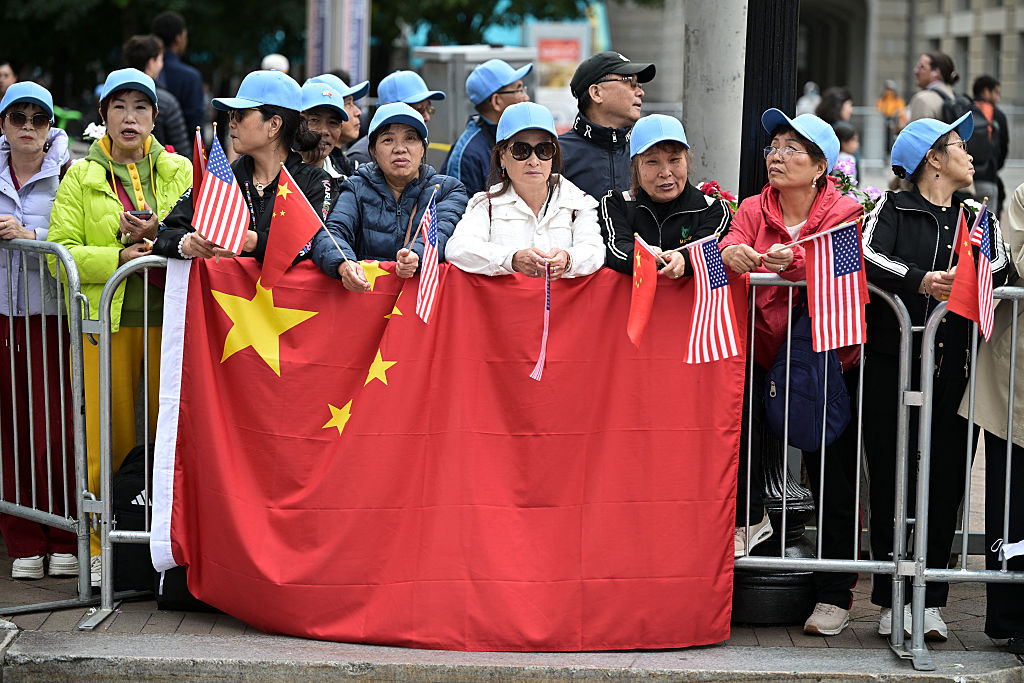
But Trump has since eased some technology restrictions, pursued a trade truce, and renewed dialogue with Beijing. Chinese President Xi Jinping arrived in Washington on Wednesday to much fanfare, marking the leaders’ third in-person meeting since Trump returned to office. Economic negotiations have been central to that diplomatic thaw, which the Chicago Council report said suggests that the Trump Administration views China primarily through an economic lens, rather than strategic competition.
Read More: China First: As Trump Meets Xi, How Beijing Sees the World Now
“The top leadership on both U.S. and Chinese sides have made significant steps to try and arrest the downward trend in their relationship,” says Dylan Loh, associate professor of public policy and global affairs at Nanyang Technology University in Singapore. “The warming trend isn’t admiration but a moderation of threat perception, driven by a shift toward viewing China as a competitor rather than an immediate adversary as other crises take precedence.”
Still, Chong cautions: “There remains a deep reservoir of apprehension” among Americans towards China.
Trump’s MAGA Republican base remains hawkish. According to the Chicago Council survey, 63% of MAGA Republicans favor containing China rather than cooperating with it, whereas 57% of non-MAGA Republicans favor cooperation. A March 2026 poll by the Chicago Council, alongside NPR and Ipsos, found that MAGA Republicans were more likely than non-MAGA Republicans to prefer higher tariffs on Chinese imports and more restrictions on U.S.-China trade, even if it resulted in higher costs for American consumers, as well as limits on Chinese international students studying in the U.S.
Skepticism towards China is also pronounced on Capitol Hill. In a Sept. 18 letter, Rep. John Moolenaar (R, Mich.), chair of the House Select Committee on China, urged the Trump Administration to restrict Beijing’s access to U.S. AI and semiconductor technology. In December, Sen. Pete Ricketts (R, Neb.) and Sen. Chris Coons (D, Del.) also introduced legislation to block exports of advanced AI chips to China.
Lawmakers have also pressed Trump to stand firm on Taiwan as the President described a pending U.S. arms package to the island as a “negotiating chip” in talks with Beijing. Moolenaar warned against concessions on U.S. arms sales to Taiwan, while Ricketts urged that the U.S. cannot allow China to take the island by force.
By contrast, public support for direct military intervention over Taiwan has declined. The Chicago Council study this week found that just 38% of Americans support using U.S. troops to defend Taiwan in case of a Chinese invasion, down from 52% in 2021.
Shifting global attitudes
The shift in U.S. attitudes comes as China’s global image has improved and America’s has deteriorated. A Pew survey published in July found that people in most of 36 countries surveyed viewed China more favorably than the U.S., a reversal from last year when the U.S. generally retained an advantage despite declining ratings.
Internationally, “perceptions of Washington’s unfriendly and unhelpful trade and security policies abroad and how it is causing problems to various countries’ own domestic economies” has driven a shift in sentiment away from the U.S., says Loh.
The Trump Administration imposed sweeping tariffs on much of the world in April 2025, and has pursued new ones after the Supreme Court struck down the bulk of “reciprocal tariffs.” The Administration has also pulled back from international institutions and foreign aid. World leaders have also expressed concern with Trump’s expansionist rhetoric towards Canada, Greenland, Venezuela, and Cuba, as well as the U.S. and Israel’s war against Iran, which has driven up energy prices around the world.
The U.S.-China geopolitical rivalry invites comparisons that can work in China’s favor, says Benjamin Ho, assistant professor and coordinator at the Singapore-based S. Rajaratnam School of International Studies’s China Program. Disillusionment with Washington may make Beijing look more appealing by contrast, even to Americans, he adds. Domestically, Trump’s job approval rating was at a record low of 32% in September, according to Reuters/Ipsos polling.
“It’s easy when you’re unhappy with things at home to instead look at your peer rival,” Ho says.
Kishore Mahbubani, a Singaporean diplomat and former President of the United Nations Security Council, tells TIME that, against the backdrop of the U.S. withdrawing from the global stage, China has come across as a more dependable partner for much of the Global South.
Meanwhile, Chinese consumer brands and cultural exports have found new audiences abroad, like Pop Mart’s Labubu dolls. On TikTok, which is owned by Chinese company ByteDance outside the U.S., users have embraced Chinese customs, like drinking warm water and practicing tai chi as part of the “Chinamaxxing” trend.
Ho points to social media exposure as a significant factor in driving youth opinion. He notes that China has toned down its assertive “wolf warrior” diplomacy in favor of a more flexible approach. Many positive depictions of China online appear to be organic, although media watchdogs previously reported that Beijing has used international broadcasting and advertising campaigns to spread propaganda.
China has taken deliberate steps to project an open, positive global image, analysts say. Beijing has expanded visa-free access for foreign tourists and sought to bring in more international students. China’s foreign ministry announced in May that more than 50,000 young Americans had visited for exchanges since November 2023. Mahbubani says that as more people visit China, they “see that Chinese cities represent the future.”
China has also invested heavily in overseas infrastructure through its Belt and Road Initiative.
Young Americans were more likely to view China warmly, the Pew survey found. Americans under 50 gave China a more positive rating than those 50 and older, although younger Americans were still more likely to view China coldly.
Earlier polling also found that younger Americans are less concerned about China’s growing global power. In a 2025 survey by the Chicago Council, just 34% of Gen Z Americans view China’s power as a critical threat to the U.S., as compared to 43% of Millenials, 56% of Gen Xers, and 62% of Boomers.