The Medical Futurist – Read More
In healthcare, blood tests are routine procedures that involve taking a patient’s blood and assessing it. The need for blood tests varies, ranging from checking the blood glucose level to checking how well a condition is being managed via medications.
Of course, in the digital health era, it is quasi-expected for blood testing to take a digital spin. Recent developments have indeed indicated that the concept of “digital blood testing” will soon be a reality. We take a look at the implications in this article.
What is digital blood testing?
Traditional blood tests have involved taking a blood sample that is sent to a lab for further analysis. The results are indicative of the patient’s health status at that point in time. If clinicians need to assess the status again, they would need to repeat the process. From there, they can establish trends and patterns, for example, the efficacy of a drug.
However, this process is not very practical and, in cases where a patient’s condition is evolving rapidly, it can lead to sub-optimal decision-making and poorer outcomes.
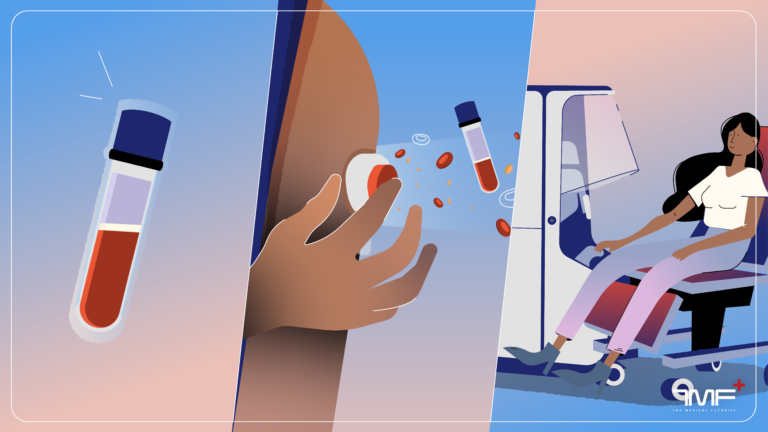
Digital blood testing aims to address such limitations. By relying on specialised sensors, biomarkers that have typically been detected in the blood are instead analysed in real-time and even continuously from the skin’s interstitial fluid or the fluid in the spaces around your cells.
Such approaches rely on skin patches with micro-needles that come into contact with the patient’s interstitial fluid. With sensors embedded in the needles and/or patch, the biomarker is analysed, and the data is stored on the patch, ready to be transferred wirelessly.
Uses of digital blood testing
While digital blood testing is a rather new concept, there are already practical examples that are materialising the vision.
Continuous biomarker monitoring and wirelessly transferring data have become an increasingly popular approach with continuous glucose monitoring. The process is moving away from needles and finger pricks with skin patches like Abbott’s Freestyle Libre and Dexcom G7. Their sensors rely on glucose level measurements in the skin’s interstitial fluid.
Another, more ambitious, example comes from digital health company Nutromics. Their Lab on a Patch is meant to be worn directly on patients’ skin. From there, the embedded microneedles coated with synthetic DNA-based sensors can monitor specific targets in interstitial fluid and wirelessly communicate the results. The company aims to use their device across medical disciplines, from infectious disease to cardiology.
While their product is still in development, Nutromics recently shared findings from a pilot trial using their technology. In it, their patch was used to monitor levels of the antibiotic vancomycin from interstitial fluid. The concentration of such drugs requires close monitoring to ensure their safe and effective dosing. Blood sampling can be challenging due to the time-sensitive nature of the monitoring required.
In the pilot, Nutromics’ patch was shown to address this issue by being able to capture the drug’s levels over 24 hours in 5-minute intervals. The study also found the use of the patch to be safe and, compared to traditional blood draws, more comfortable.
The impact of digital blood testing
The limited number of practical examples of digital blood testing is indicative of the nascency of the concept. However, it is showing promise, as exemplified by a growth in continuous glucose monitoring patches in recent years.
Digital blood testing solutions can address more than technical challenges. They also offer a practical edge. In particular, fear of needles is very real, affecting at least 1 in 10 people. By means of a patch that overrides the need for regular blood sampling, biological assessments are made more convenient and accessible. This approach also holds promise for chronic disease management and at-home care.
While a future with digital blood testing is shaping up, there will likely still be the need for actual blood tests, such as to assess blood cells. These might also evolve to be less invasive and, as with digital blood tests, they will need to undergo clinical trials to ascertain their safety and efficacy.
Written by Dr. Bertalan Meskó & Dr. Pranavsingh Dhunnoo
The post What is digital blood testing? appeared first on The Medical Futurist.