TIME – Read More
The Russian exclave of Kaliningrad on the Baltic Sea has the potential to become a flashpoint with NATO as recent maritime security incidents between Russia and Ukraine bring renewed attention to the territory nestled between two NATO members.
Moscow on Monday announced the allocation of approximately 47 billion rubles (around $572 million) toward the construction of two railway ferries between the Russian mainland and Kaliningrad, which sits between Poland and Lithuania.
Prime Minister Mikhail Mishustin said the aim is “to ensure the region has an uninterrupted supply of essential goods and raw materials.”
Russia relies heavily upon the ice-free port of Kaliningrad, especially since 2022, when Lithuania restricted the transit of certain Russian goods in line with E.U. sanctions put in place following Russia’s full-scale invasion of Ukraine. In 2025, around 52% of goods in and out of the territory were transported via sea, compared to just 8% via the same route in 2021, according to data shared by officials belonging to Rosmorport, a Russian state-owned port operator.
The planned railway ferries come amid concerns from Russia that NATO could use its Baltic presence to isolate Kaliningrad, presenting Moscow with a potential military challenge as the exclave is considered to be a vital asset. According to quotes carried by Russian state media, Mishustin said the investment was needed due to “the illegal actions of certain countries, disruptions to supply chains, and attempts at transport blockades [that] hinder the operations of businesses located there.” He did not specify which countries or specific actions he was referring to. TIME has reached out to Mishustin’s office for further comment.
The news came shortly after Sparta II, a Russian cargo vessel that was bound for Kaliningrad, was struck in the Gulf of Finland on Nov. 21. Ukrainian President Volodymyr Zelensky said Kyiv was responsible for the assault, arguing that Sparta II had been carrying military supplies and was therefore a credible target.
Kremlin spokesperson Dmitry Peskov criticized the attack as an example of a “dangerous trend of expanding terrorist activity in the Baltic region.”
Russia is aiming for the ferries to go into operation in 2030, traveling between the ports of Ust-Luga in Russia’s Leningrad region and Baltiysk in Kaliningrad.
The investment plan “shows that Russia thinks [Kaliningrad] is potentially a long-term vulnerability,” says Natia Seskuria, head of the Russia, Eurasia, and Black Sea security programme at the Royal United Services Institute think tank. “Given the current security environment, and as [Russia] does not expect that this will necessarily ease, they’re preparing for a long-term scenario.”
On the same day the Russian vessel was struck in the Baltic Sea, Kaliningrad’s governor Alexei Besprozvannykh said that a drone alert had been activated near the Lithuanian border. He claimed it was triggered by a “suspicious object coming from the direction of Lithuania.” Kęstutis Budrys, Lithuania’s Foreign Minister, staunchly rejected claims his country was involved in the incident. “The Republic of Lithuania has never authorized the use of its airspace for attacks against targets in the Russian Federation, including in the present case,” he said.
“NATO already perceives Kaliningrad as a potential flashpoint,” says Seskuria, arguing that these recent incidents will likely have raised pre-existing concerns.
In late September, Russia sent a document to NATO warning it would be open to resorting to the use of nuclear weaponry if NATO attempted to isolate Kaliningrad.
Russian embassies in European countries including Ireland, the U.K., and Belgium issued statements accusing NATO of escalating tensions by conducting military exercises and planning scenarios “specifically aimed at the Russian enclave of Kaliningrad at the coast of the Baltic Sea.”
NATO Secretary General Mark Rutte told reporters on Sept. 30 that NATO had been “clear” in its response to Russia. “Basically what we said is, ‘Hey, listen, we are [a] defensive alliance, and stop the nuclear threat. This is absolutely not called for and not helpful. And particularly stop the war in Ukraine, which is [an] unprovoked war of aggression against Ukraine,’” he said. Russia’s Foreign Ministry spokesperson Maria Zakharova later dismissed NATO’s concerns, asserting that “ordinary Europeans are being scared with apocalyptic scenarios” in reference to the talk of nuclear threats.
The Baltic region has become particularly important within the context of NATO-Russia relations, with Finland and Sweden, both of which border the body of water, becoming members of the alliance in 2023 and 2024 respectively.
With Kaliningrad proving to be a long-standing point of tension for NATO and its allies, here’s what to know about the strategically-important Russian exclave.
What and where is Kaliningrad?
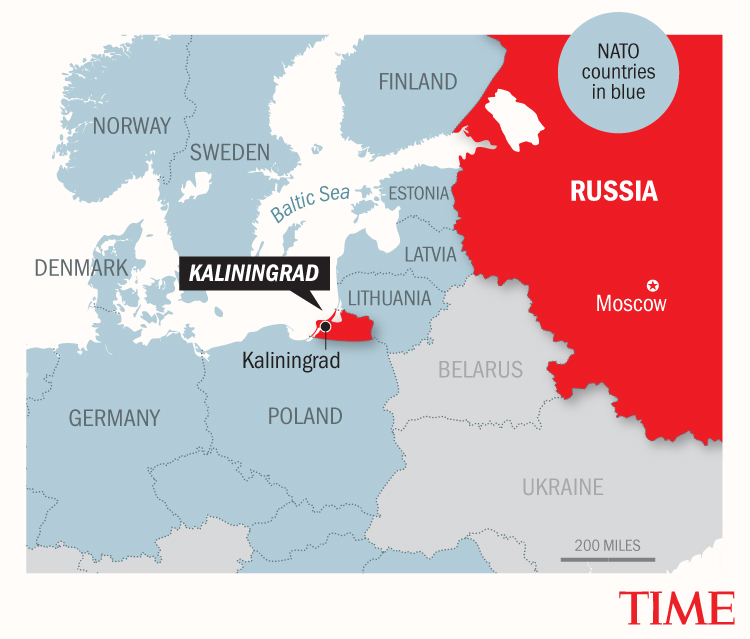
The Russian exclave of Kaliningrad is sandwiched between NATO countries Poland and Lithuania.
Kaliningrad refers to both the exclave as a whole, an area that spans around 5,830 square miles, and the territory’s largest city.
The city of Kaliningrad is around 400 miles away from Russia’s main landmass.
As of June 2025, the region’s total population stands at just over 1 million, around half of which live in the city of Kaliningrad.
What is the history of Kaliningrad?
It was formerly part of Germany’s East Prussia region. Following World War II, part of East Prussia was ceded to the Soviet Union, with the rest given to Poland in alignment with the Potsdam Agreement signed by Allies in August 1945.
The city of Koenigsberg was subsequently renamed Kaliningrad in honor of Mikhail Kalinin, who had served as the head of state for the Soviet Union.
Why is Kaliningrad strategically significant?
Due to its positioning deeper within Europe and its access to the Baltic Sea, Kaliningrad has become a key stronghold for Russia.
“Russia has always seen Kaliningrad as a launching point for potential aggression against Europe, and as they have moved to a further threatening posture against NATO member states, Kaliningrad is of course important to support that,” says Mason Clark, director of the Defense of Europe Project at the Institute for the Study of War.
Moscow has therefore bolstered the territory with military capabilities, particularly in recent years. “Russia has S-300 and S-400 air defense systems based there, as well as, most importantly, Iskander-M systems, which are nuclear capable,” says Seskuria.
Kaliningrad’s ice-free port is also vital for Russia’s naval operations in the region, because it means “vessels can transit in and out of the port at all times of year,” Clark notes.
“While Kaliningrad gives Moscow a base from which it can directly threaten Baltic states and Eastern Europe in general, its geography also makes it vulnerable,” says Seskuria. “Russia has always stressed on heavily fortifying and militarizing this exclave.”
Tensions between Russia and NATO members over Kaliningrad
Escalating tensions came to the forefront in May when Lithuania’s Foreign Minister Budrys said NATO must have a firm response to any Russian aggression and would have to show Moscow it was capable of penetrating Kaliningrad.
In an interview with a Swiss newspaper, Budrys said: “We have to show the Russians that we’re capable of penetrating the small fortress they’ve built in Kaliningrad. NATO has the capability, if necessary, to raze Russian air defenses and missile bases there to the ground.” Peskov responded by saying the statement verged “on insanity” and insisted it was a sign that the Baltic states exhibit “anti-Russian” sentiments.
In September, Russia sent NATO a document indicating it would be open to a potential nuclear response if the alliance attempted to cut off Kaliningrad.
Amid a broader conversation about security, Estonia’s Foreign Affairs Minister Margus Tsahkna warned that NATO could close the Baltic Sea “within hours,” cutting the Russian economy’s maritime “lifeline” via the Gulf of Finland if Putin were to carry out any attack that triggers NATO’s Article 5 clause.
Should a conflict break out between Russia and the alliance, Moscow would likely look to cut off Baltic nations from the rest of NATO by seizing the Suwalki corridor, a 40-mile stretch of the Poland-Lithuania border flanked by Kaliningrad and Belarus, Russia’s regional ally, experts tell TIME.
“The Russian military would [potentially] try to close the Suwalki corridor between Kaliningrad and Belarus in order to prevent NATO from being able to reinforce the Baltic states by land,” says Clark, emphasizing that this would be a “maximalist scenario” and a full-scale war is highly unlikely at the moment.