TIME – Read More
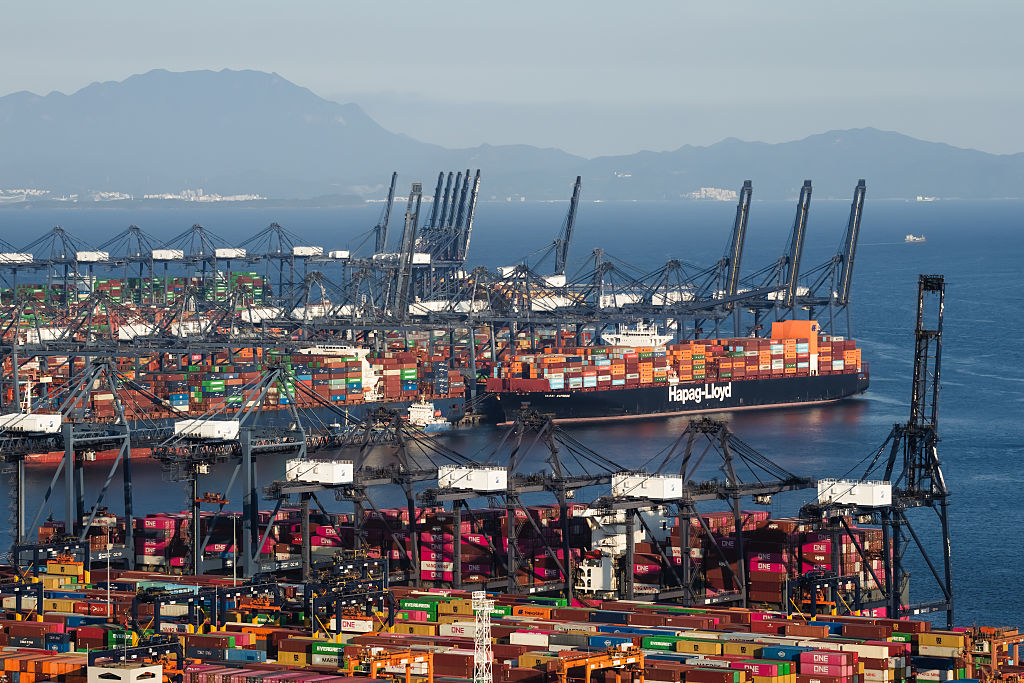
The U.S. and China have agreed to cut tariffs on $60 billion worth of goods, from U.S. coal to Chinese toys.
The late Sunday announcement falls under the “30-for-30” framework, covering roughly $30 billion of U.S. exports to China and $30 billion of Chinese exports to the U.S. The U.S.-China Board of Trade, established during President Donald Trump’s visit to Beijing in May, recommended more favorable tariff treatment for “non-sensitive” products.
The proposed cuts would bring relief to a wide range of goods, including live horses, camels, and fishing tackle. The White House has not yet specified the size of tariff reductions or when the cuts will be implemented, although the Chinese Commerce Ministry said tariffs on around 90% of the products on each list would return to “most favored nation” levels, referring to ordinary baseline tariff rates that vary based on product.
Read More: America, China and the Evolving New World Order
TIME has reached out to the White House and Chinese Commerce Ministry for comment.
“The Trump Administration will continue to pursue fair, balanced, and reciprocal trade with China by ensuring compliance with commitments on agricultural and energy purchases, pursuing balanced trade in non-sensitive goods, and securing market access for American farmers, manufacturers, businesses, and workers,” U.S. Trade Representative Jamieson Greer said in a statement on Sunday.
The Chinese Commerce Ministry said on Monday that the agreement would “further stabilize” U.S.-China trade relations and “create favorable conditions” for Chinese exports to the U.S.
The agreement marks the latest effort to ease economic tensions between the two global superpowers after an escalating trade war last year brought tariffs to prohibitively high levels. It comes days after Chinese President Xi Jinping and Trump met in Washington, D.C., and agreed to extend a trade truce until Jan. 10. The two countries have repeatedly extended their trade truce since May 2025, when they agreed to lower additional duties to 30% on Chinese goods and 10% on U.S. goods. After the Supreme Court struck down Trump’s emergency tariffs in February, the Trump Administration imposed a separate 12.5% levy on many Chinese products, on top of earlier Section 301 tariffs targeting Chinese trade practices and Section 232 sectoral tariffs.
Trump has sought to use tariffs to shrink the U.S. trade deficit with China and bring manufacturing back to the U.S. Greer told CNBC on Friday that the deficit on goods trade with China has fallen by 40% since Trump took office. The deficit is on track to hit $140 billion this year, he said, compared to $295 billion in 2024, according to Census Bureau data.
But the tariff war has also strained both economies and pushed Chinese exporters to seek other markets. American business owners previously told TIME that abrupt tariff changes had driven up costs and forced them to consider shifting production out of China, which could be prohibitively expensive.
Read More: Surveys Show More Americans Warming to China
“This is less the demolition of a tariff wall than the opening of a safety valve: enough to let off steam, not enough to change the structure of the conflict,” says Henry Gao, professor of law at Singapore Management University. “It may give both sides breathing room, but it is better designed to pause a trade war than to end one—and may simply prepare the ground for the next round of fighting.”
Deborah Elms, Head of Trade Policy at the Singapore-based Hinrich Foundation, tells TIME that the cuts “are a mostly symbolic way of indicating that tariffs can be cut without tackling the major challenges.”
But, she adds, it’s still a positive: “At a minimum, it provides a mechanism for future conversations about trade and tariffs which might be more serious.”
What products are covered?
The agreement recommends lower tariffs on 77 categories of Chinese products. These include bed linen, garden umbrellas, car seats, fish hooks, billiard balls, curtains, electric shavers, inflatable balls, and jute wall hangings. It also includes holiday decorations, which could bring relief to U.S. businesses if implemented before the end-of-year holiday season.
The agreement also recommends lowering tariffs on 1,619 categories of U.S. products. These include a range of food items, like butter, offal, corn, wheat, frozen meat, seafood, and foie gras. It also recommends reduced tariffs on cosmetics, wood products, scientific devices like MRI systems, rabbit hair, and coal. Several types of live animals are also included: donkeys, mules, horses, whales, dolphins, and dugongs.
Washington’s focus on “everyday Chinese consumer goods,” Gao says, demonstrates “an effort to lower household costs and offer voters tangible price relief ahead of the midterm elections” in November. For Beijing, the American goods on its list, including agriculture, energy, timber, and medical equipment, “address domestic needs while also benefiting politically influential U.S. constituencies,” he says.
China’s “extremely long list” covers a huge amount of goods that are not exported to China in significant amounts,” Elms adds.
Zhu Tian, vice president, co-dean, and professor of economics at China Europe International Business School in Shanghai, tells TIME the choice of products reflects a “cautious” approach, suggesting the agreement is more “a confidence-building measure” between the two sides.
The White House also said on Friday that China agreed to import at least 10 million metric tons of coal per year from the U.S. in 2027 and 2028. China previously agreed in November to resume purchases of U.S. sorghum and increase purchases of U.S. soybeans.
During Trump’s first term, China pledged to increase its purchases of U.S. agricultural products, including soybeans, but fell short of certain commitments.
What is the “30-for-30” framework?
Under the so-called “30-for-30” framework, the U.S. and China respectively recommended $30 billion worth of non-sensitive trade, based on 2024 trade values, that “could benefit from more favorable tariff treatment in the future,” Greer said on Sunday.
The list would improve market access for roughly 30% of U.S. exports to China, Greer said.
The Board of Trade “gives the détente an institutional framework,” Gao tells TIME. But he notes that it has avoided “the core disputes over technology, subsidies, industrial policy, and national security.”
Many of the concessions, which are likely to be implemented through domestic measures rather than binding treaty commitments, could be easily reversed, he cautions. And with the truce set to expire in January, Gao says “this looks less like durable peace than a half-time break in a boxing match between two heavyweights: both sides get a breather, but the bell has not rung for the final round.”
Sensitive goods, which are excluded from the framework, include semiconductors, batteries, and electric vehicles. “Both governments are liberalizing where it is politically useful, while preserving pressure where it is strategically necessary,” Gao says.
Still, the “30-for-30” framework could become a “useful template for quick, transactional trade bargains” between the U.S. and other countries, Gao says. Such a framework would allow countries to “match concessions by dollar value, shield strategic sectors, and deliver politically visible wins without the burden of negotiating a comprehensive trade agreement.”
What does this mean for businesses and consumers?
The amount of goods covers roughly 21% of U.S. exports to China and 7% of Chinese exports to the U.S. based on 2024 trade values, which put U.S. exports to China at $143.5 billion and Chinese exports to the U.S. at $438.9 billion. The tariff cuts “offer meaningful relief to particular exporters, importers, and consumers,” Gao says, although he cautions that it remains a proposal and is not yet implemented.
Lingering uncertainty, including over whether the trade truce will extend beyond Jan. 10, could still make it harder for businesses to plan, particularly those that began exploring alternative suppliers during last year’s tariff war.
“Equal trade values do not necessarily produce equal economic gains, and easily reversible tariff cuts offer businesses little certainty for long-term investment or supply-chain planning,” says Gao.
Notably, U.S. whole soybeans are not on China’s list and still face an additional 10% tariff. The crop has been a key bargaining point in trade talks after Beijing reduced purchases of the product, taking a toll on American farmers.
“Clearly, if you are an American importer that has not yet received your Christmas ornament orders, these cuts are going to be helpful,” Elms says, referring to the inclusion of wooden Christmas ornaments and artificial flowers on the U.S. list of Chinese products. “But in the main, the tariff cuts on offer are not going to relieve economic pressures on consumers in either market.”