The Medical Futurist – Read More
According to recent reports, Meta is winding down its metaverse investments in favour of AI glasses and wearables. Despite the lack of popularity of the metaverse, it is a somewhat surprising move for Meta. After all, it is the company that changed its name to emphasise its commitment to the concept of a universe of interconnected virtual worlds.
Nowadays, Meta seems to be more popular as the maker of the Ray-Ban-branded AI-enabled smart glasses. However, Meta is far from the only company in this space, and it was far from being the first either. Smaller companies like Brilliant Labs have a few generations of such products, and bigger players like Google and Apple are reportedly planning to launch competing models. In other words, the race is officially on to put computers on our faces, and analysts expect a massive growth in this market.
With real momentum behind such hardware, it will only be a matter of time before these devices are applied to healthcare settings, if they haven’t already. But will smart glasses in healthcare become meaningful tools, or will they become yet another gimmicky tech? We decided to investigate, with insights from Brilliant Lab’s CEO, Bobak Tavangar.
What are AI-enabled smart glasses?
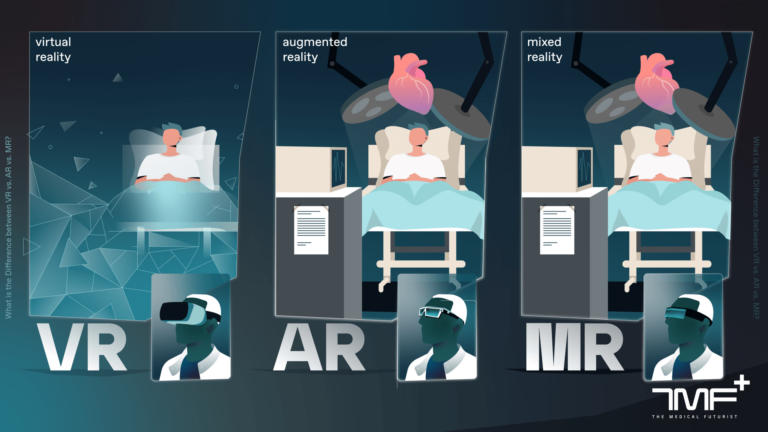
It’s worth making the difference with other smart head-worn devices here. In particular, augmented reality (AR), virtual reality (VR) and mixed reality (MR) headsets share similar features to smartglasses, but pack more advanced technology and are typically bulkier. Smartglasses can be somewhat considered as very simplified versions of these headsets.
Meta might have popularised AI-enabled smart glasses in recent years, but such devices existed well before the company’s foray into this space. They were marketed to consumers towards the late 2010s by small companies like Solos, and would simply be termed as “smart glasses” or “audio glasses”. This is because they would look like regular glasses with tiny speakers in each temple, without any display or camera. They would allow users to take calls, listen to music or query a voice assistant like Siri or Google Assistant.
In the early 2020s, companies started to experiment with integrating displays and cameras in such glasses. Some, like the XREAL glasses would operate with a smartphone connection, while others, like the INMO glasses, would work independently.
During that time, one startup took an unusual approach. Brilliant Lab’s first smart glasses, the Monocle, was an open-source, developer-focused device that could attach to your current glasses. It was among the first to bear the moniker of “AI glasses”.
“So we really saw this opportunity not just to make a beautiful thing that’s priced well, but to do a device that harnesses artificial intelligence to amplify your latent powers of mind and speech and understanding,” Bobak Tavangar, CEO of Brilliant Labs, told us. “Because something like glasses is something that many of us wear all day, every day. And if AI can do that for you, you all of a sudden become a super version of yourself.”
The company will soon release its third product, the Halo glasses, and it shares similarities with other devices in the market. It seems like, currently, the more common features of smart glasses include embedded displays, a front-facing camera, a microphone, and integrated speakers. Most of these devices come with a companion smartphone app that supports AI interactions. This array of technologies has its practical healthcare uses but also raises some concerns.
Current practical uses of smartglasses in healthcare
Smartglasses might sound like a pricey end-of-year gift for the tech-savvy person in your life, but they have practical healthcare uses. So far, the biggest beneficial use case has been accessibility for those with vision and hearing impairment. Glasses are typically used to aid in vision correction, but with additional sensors, they bring other layers of accessibility.
The Rokid Glasses, for example, can address farsightedness by making small prints more legible on the glasses’ own display with an adjustable font size. The same device can provide real-time closed captions by transcribing what a speaker is saying and displaying it on the screen. This can be beneficial for people with diminished hearing and even help with translation. This indicates an exciting future where smartglasses could pack a hearing aid feature, akin to the AirPods Pro 2, making such accessories feel more seamless and less stigmatised.
In fact, companies and researchers are investigating such versions of smartglasses. Nuance Audio markets its Nuance Audio glasses as an “invisible hearing aid solution”. The frame features an array of six microphones to capture sound and amplify it via the integrated speakers.
Researchers in Scotland have developed a pair of smartglasses that uses an embedded camera to track a speaker’s lip movements, apply lip-reading technology and AI removal of background noise to enhance hearing. Project lead Professor Mathini Sellathurai considers these glasses as providing hearing aids with superpowers, and expects a working prototype to be available in 2026.
Such meaningful use cases for smart glasses gave Brilliant Labs the conviction to go the open source route for their devices. “Regardless of whether you’re hard of hearing or hard of seeing, there is a sensor for you; that’s why it’s open,” Bobak Tavangar told us. “There’s a lot of software developers out there building for these communities who can hook into our platform and deliver an experience for them.”
Future potential uses of smartglasses in healthcare
Improving accessibility seems to be the most immediate impact of smartglasses in healthcare, but they hold more potential down the line. While current smartglasses can be considered as simplified AR devices, they might replace these bulkier counterparts as technology progresses. AR and MR devices are already in use for medical training and anxiety disorders, but having more compact tools like smartglasses would be more convenient.
The Google Glass, Google’s failed attempt at consumer-oriented smartglasses from 2012, even found a brief home in surgical uses. Other companies are taking it where it left off. For instance, Snke OS GmbH recently revealed the SnkeXR, an open platform AR glasses dedicated to healthcare uses. It is packed with a range of clinically-oriented features such as a built-in surgical tracker and stereoscopic loupe magnification. These make its use cases wide-ranging, from clinical training to remote assistance.
There is even the possibility for smart glasses to become healthcare companions. The second generation of smart glasses from Even Realities provides such an indication. The Even Realities G2 can be paired with the Even Realities R1, a smart ring that can monitor health metrics such as heart rate, temperature and steps. These readings can be mirrored to the glasses’ display, without the need to look at your phone.
Brilliant Labs’ CEO thinks that smart glasses can have a more proactive role in healthcare in the future. Aside from eye health, sensors directed at the retina could work like an early warning detection system for the rest of the body, he told us.
An eye on the new concerns
After over a decade of trying to find a sure footing, consumer-grade smartglasses appear to be ready for adoption, even within healthcare. However, the new tool presents new challenges, especially in relation to privacy.
As smartglasses increasingly adopt front-facing cameras, the issue of privacy is paramount. Products from data-hungry and ad-supported companies like Meta and Google can represent a privacy nightmare.
Brilliant Labs’ Bobak Tavangar believes that we need to provide AI with “eyes” to fulfil the technology’s potential. As such, his company sees cameras as a necessity for AI-enabled smartglasses. “The reason is that it needs to mimic your biological sensors,” he explains. “Not only hearing what you hear, but it needs to see what you see.”
The open-source nature of their devices makes them more privacy-focused than their big tech competitors, as Brilliant Labs’ system is explainable and modifiable. The rich data captured by their glasses is sent to your phone only for AI inference, not for social media captures or storage. After an AI model does inference, that data is tossed away and not stored.
“We’re not making money by mining your eyeballs and selling them to the highest paying advertiser,” Tavangar adds. “We think about both open source and privacy as two really interlocking elements.”
Still, other competitors in this space have a different approach to AI glasses. Models from companies like Even Realities and Halliday do not have a camera, specifically to prioritise privacy and make for a product that is more readily adopted. These glasses can mirror a phone’s notifications and rely on AI interactions, such as queries or note-taking, rather than for full-on content consumption.
Despite the diverging philosophies in terms of privacy, most of these devices are still practically impossible to repair. Brilliant Labs’ glasses might be the exception, as the hardware is open source and can be fixed with 3D printed parts, but the competition offers pricey, fragile glasses. If they are damaged, your local optician might not be able to fix them, and they can become impediments, rather than accessibility devices.
There is definitely a place for smart glasses in healthcare, but their adoption should not come at the expense of privacy or accessibility. There is no perfect solution as of now, but with an expanding market and vibrant competition, we might see more healthcare-specific and privacy-focused options become available in the near future.
Written by Dr. Bertalan Meskó & Dr. Pranavsingh Dhunnoo
The post Smart Glasses In Healthcare: The Current State And Future Potentials appeared first on The Medical Futurist.