HealthPopuli.com – Read More
Are women “seen?” And how do they see themselves compared with how companies see them — marketers, leaders, and any enterprise that’s trying to message and persuade women to calls-to-action?
If you are working to inspire, influence, or engage that portion of the world’s population who are women, then a new study from 8th-Day brand consultancy can inform your strategies. It’s titled Hidden Women: Unlocking brand growth by seeing the unseen, and it’s chock full of insights and lightbulb moments from which you can benefit.
In full and delightful disclosure, the 8th-Day team are some of my favorite collaborators over the years, with this report led by one of those faves, Chloe Williams, a partner at the firm.
To gauge women’s views on being “SEEN,” 8th-Day conducted survey research among 2,700 women across North American, ages 16 to 74, in the winter season of 2025.
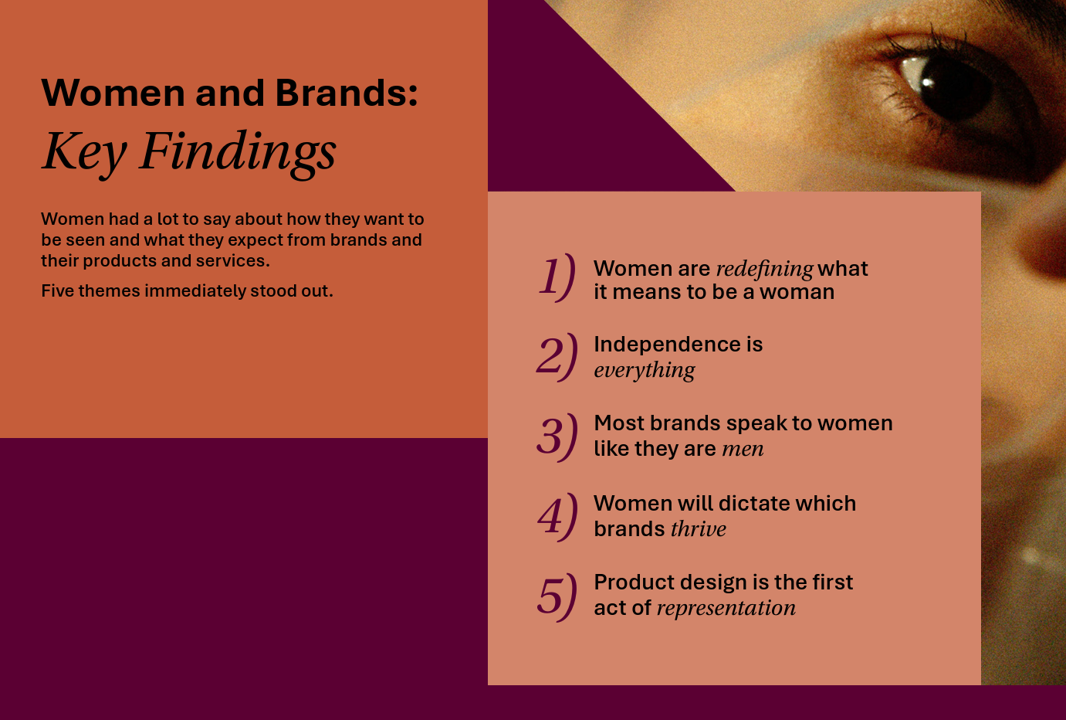
The report lays out five key findings from the research (italics from the report):
- Women are redefining what it means to be a women
- Independence is everything
- Most brands speak to women like they are men
- Women will dictate which brands will thrive, and,
- Product design is the first act of representation.
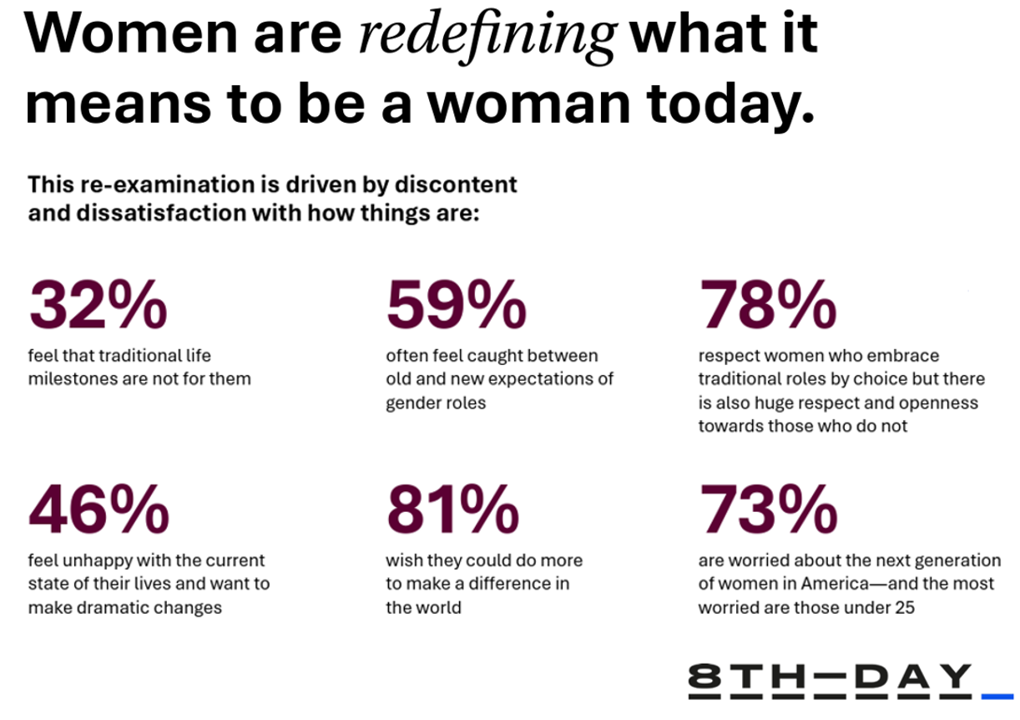
Start with women redefining the meaning of being a woman today. Nearly one-half (46%) of women feel unhappy with the current state of their lives and want to make dramatic changes — with 59% of women often feeling caught between old and new expectations of gender roles.
Three in four women are worried about the next generation of women in America — with the most worried women being under the age of 25.
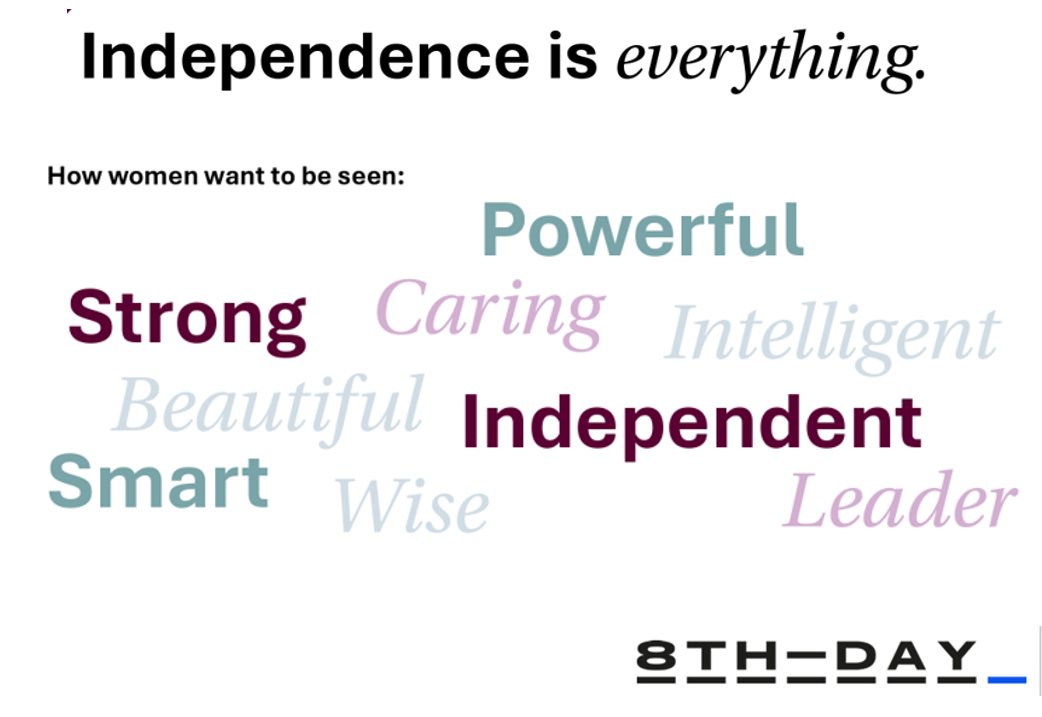
“Independence is everything,” 8th-Day found. For women, independence means not being reliant on others to support them, having more agency over decisions and doing things their own way, feeling fully capable, competent, and prepared, and, accessing tools, products and services that support self-sufficiency.
Importantly, 9 in 10 women believe that money is central to independence — and this is true for 4 in 5 stay-at-home parents as well.
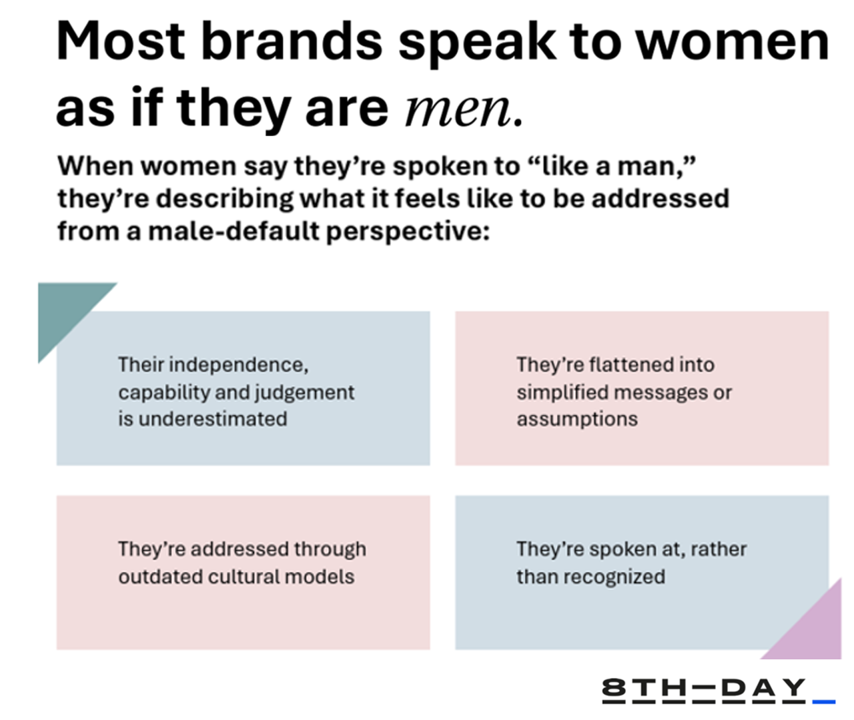
One of the most striking findings in this study is that women say most brands speak to them as if they are men — feeling underestimated in their capabilities and judgment, feeling flattened into simplified messages or assumptions, feeling addressed through outdated cultural models, and having a sense of being spoken “at” versus being part of a conversation in feeling recognized.
One aspect of this communications gap applies to the labels used by brands to establish women’s identities, versus the labels women feel are aspirational. Consider on the most-used labels, nouns like, “Professional/Career Woman,” “Homemaker,” “Feminist,” “mother,” or “Trad Wife.”
On the aspirational aspect, consider “Independent Woman,” “Free Spirit,” “Creative,” and “Wise Woman,” 8th-Day reported.
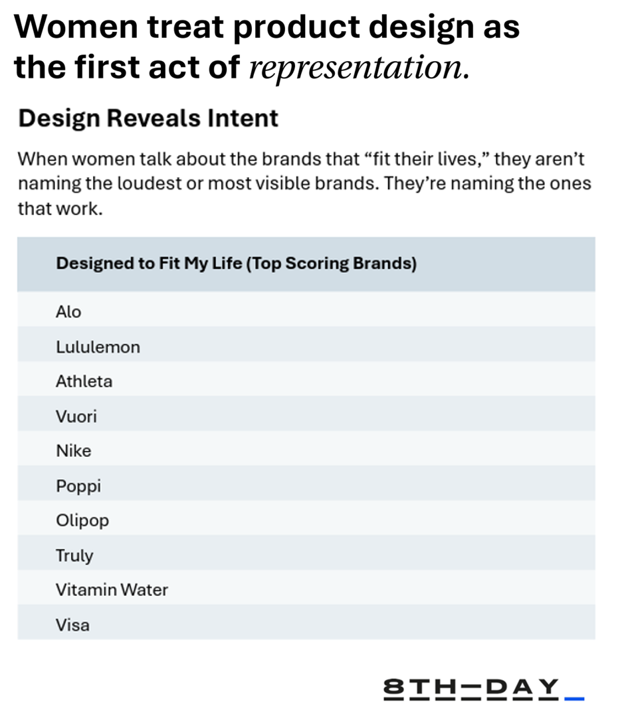
Here’s another useful lesson to keep in mind — that product design as, in the eyes of women, “the first act of representation.”
It’s not about the ad: it’s about the core of product design.
8th-Day surveyed dozens of brands asking women to identify those that make them feel “seen,” those that give a “glimpse” into them, those making them feel “overlooked,” and at the bottom of the roster, brands with a “blind spot” to women.
In terms of design savvy to “fit my life,” women pointed to brands such as Alo, Lululemon, Athleta, Vuori, Nike, Poppi, Olipop, Truly, Vitamin Water, and Visa.
Note the density of fitness/health oriented brands on this design-ful list.
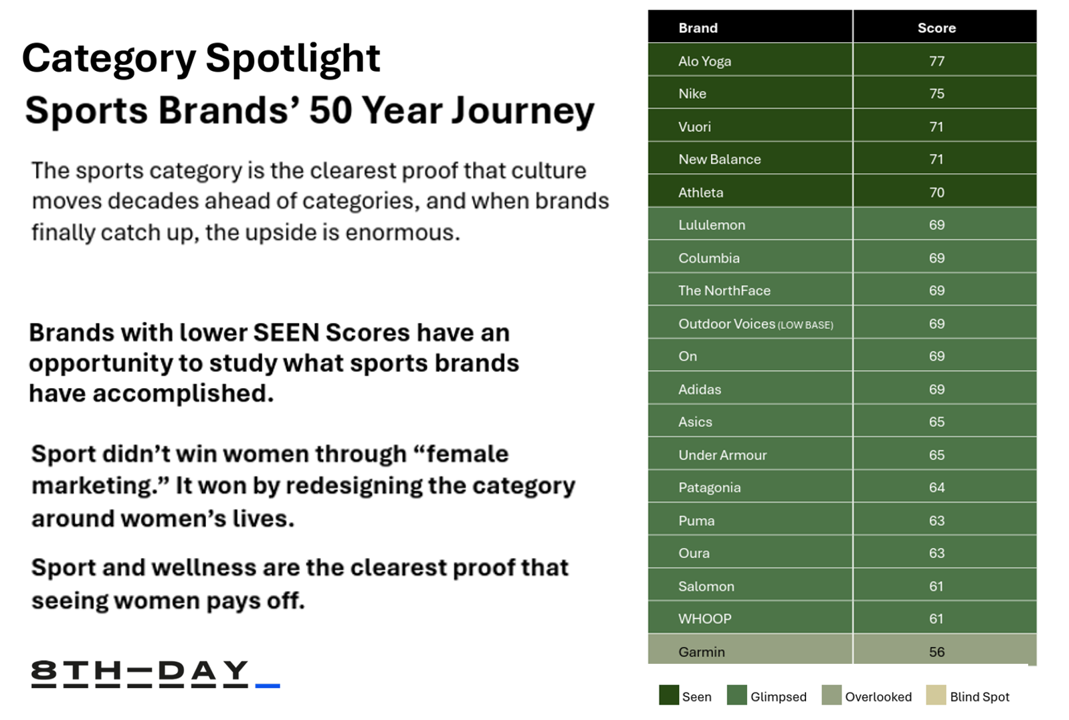
Thus, it’s useful to look at sports brands’ 50-year journey, which is a very informative part of this report especially if you work in the health (and retail health, self-care) space.
The key learning is that “sport didn’t win women through ‘female marketing.’ It won’t by redesigning the category around women’s lives.” You can review the list of sports-minded companies here, and which organizations succeeded in designing around a woman’s life compared to others. I’ll call out that the wearable tech vendors Oura, WHOOP, and Garmin, came out lower than others in the list — with room to improve.
8th-Day offers a “Unifying Principle” at the conclusion of a lot of data, only some of which I’m sharing here. But you can access the entire report at the link above. Check out the report to find out what that is, encouraging you to read the entire report. : )
For me in the work I’m doing in retail health, self-care, and the home as our hub of individual and family health/care, I am drawn to a lesson in the report on “building community as infrastructure, not a campaign.” Three in 5 woman say they are drawn to brands that build genuine community — through physical and digital spaces designed for participation, ongoing; and, serving up rituals, classes, and shared language that rewards consistency — think of this as a loyalty bridge.
Start “seeing” women even more acutely than you may be doing now. Doing so leads to the end-game of that Unifying Principle — where 8th-Day notes,
“That’s not a woman’s strategy.
It’s a future growth strategy.”
Kudos to Chloe Williams and other fave touchpoints at 8th-Day, Stu Enticknap and Laura Davis.
The post Most Brands Speak to Women As If They Are Men: Learning from Hidden Women, Health Marketing Insights from 8th Day appeared first on HealthPopuli.com.