The Medical Futurist – Read More
For centuries, scribes have been part of the medical corpus, documenting events and performing administrative tasks. They shadow clinicians during their consultations to document the encounter in real-time, which is then reviewed and signed off by the clinician. In the digital health age, their tasks have evolved to work with electronic health records (EHRs) and even remotely.
More recently, AI scribes have indicated the next stage in the evolution of medical scribes. These software rely on speech recognition and large language models to automate, in real-time, clinical documentation during doctor-patient encounters.
Such tools have the potential to support administrative tasks and recent reports even indicate that medical AI scribes are helping clinicians save time. It got us to wonder how much time these tools can actually help save. The answer is more nuanced, and we unpack it in this article.
How can medical AI scribes save time?
On average, clinicians take 16 minutes to document each patient encounter on electronic health records. In some cases, this can even amount to at least two hours of typing for a full clinical day. With such time-consuming, repetitive tasks, automation can be a saving grace, especially considering that operating EHRs is among the major contributors to clinician burnout.
With medical AI scribes, there are some common practical ways that clinics can save time. This is usually during the post-visit period, where physicians would typically need to document the patient encounter. With an AI-generated draft ready for their review, they have less time to spend writing an initial draft by recalling specific details. The knock-on effect is that, with an AI scribe documenting in the background, there is less backlog and more attention that physicians can dedicate to patients.
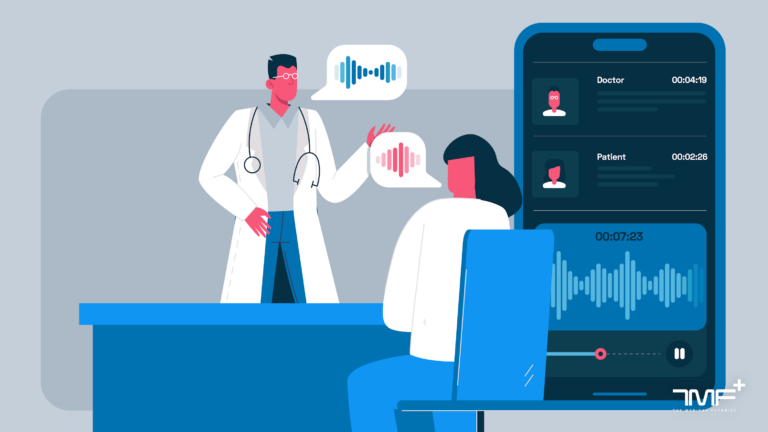
This does not imply that human scribes are not required. Clinics that already employ scribes can enhance their work by collaborating with AI. As human scribes have better context than AI scribes, they can provide more accurate edits. After all, even if an AI tool can generate a fast draft, the time it saves might be nullified if significant editing is required in order to finalise the documentation process.
Can medical AI scribes actually save time?
With the convenience that medical AI scribes promise, healthcare institutions are increasingly considering their integration. This has also prompted researchers to investigate the actual benefits of such tools. Recent studies from the US have indicated that by having AI scribes handle documentations, physicians report less burnout, and their time spent on EHRs and documentation has been cut. More specifically, they were found to spend 8.5% less total time in the EHR and spent 15% less time composing notes.
“At first glance, an 8.5% reduction in documentation time might seem small, but when you do the math, a clinician who sees 20 patients per day and saves two or three minutes per patient by using an ambient AI scribe could recoup multiple hours per week,” explained Dr Kevin Pearlman, one of the study leads.

Across the Atlantic Ocean, a large-scale study of medical AI scribes’ impact on administrative burden was conducted at Capio, the Nordic region’s largest private health provider. It analysed over 375,000 medical notes created using Tandem Health’s AI Scribe by 1,295 clinicians. With the technology, they spent 29% less time on medical notes, which equates to a reduction from 6.69 minutes to 4.71 minutes per note.
To wrap our heads around the numbers, here’s a quick summary of the research findings:
- US studies: 8.5% less total time in the EHR and spent 15% less time composing notes, or about 2-3 minutes saved per patient.
- European study: 29% less time on medical notes, or about 2 minutes saved per note.
The Nordic study also highlighted notable benefits beyond time efficiency. They found that clinicians using the medical AI scribe felt more present during consultations, were less stressed from administrative tasks, and 80% underscored that the tool improved their profession. This has some parallels with US-focused studies, which found medical AI scribe users to be less stressed, experience less burnout and feel more content with their work.
The nuances of automated time-saving
Based on such findings, medical AI scribes can indeed, technically speaking, save time for clinicians. The savings might be a handful of minutes per consultation, but this can add up to hours per week. However, there are more nuances to these results.
In another recent US-based study published in Nature, researchers highlighted that while medical AI scribes can reduce documentation turnaround time, they can induce new time burdens. These include increasing the number of required steps in reviewing documentation and associated phone calls. Other studies have identified that these tools can improve clinician wellbeing but not necessarily save their time; or that, despite positive, subjective impressions of AI scribes, actual measured time savings were relatively modest on average.
Furthermore, retention in use might be a challenge. The Permanente Medical Group shared insights on the implementation of AI scribes after one year and over 2.5 million uses. Out of the 10,000 physicians using the technology, 73% used it at least once, but only 34% employed it in at least 100 patient encounters. The most frequent users were among mental health, primary care, and emergency medicine specialists, and accounted for 89% of the tool’s total usage.
Therefore, medical AI scribes might be more likely to be adopted by a specific segment of clinicians, even if national incentives are present and the technology continues to attract investments (over $1 billion in 2025 alone). This might indicate the relative infancy of the technology’s implementation, and more research (and time) might be required to have definitive answers.
Researchers are also pointing to the risk of adoption rates outpacing validation and oversight. This harkens back to reports suggesting that about 90% of notes generated by Nuance’s AI scribe during trials at Stanford Medical School had to be manually edited for inaccuracies. Others have found that some AI transcriptions can even include harmful hallucinations or made-up content.
These represent real risks that can compromise patient safety and clinical rigour in the rush to deploy AI scribes. A more measured approach, with the support of policymakers and adequate safeguards, would ensure efficient and sustainable implementation in practice.
Written by Dr. Bertalan Meskó & Dr. Pranavsingh Dhunnoo
The post How Much Time Can AI Scribes Save? appeared first on The Medical Futurist.