The Medical Futurist – Read More
Everyone talks about artificial intelligence in medicine. Every week brings another model, another benchmark, another demonstration of something AI can suddenly do better, faster, or more cheaply than before.
But understanding the context around this breakthrough technology when news either talks about doomsday scenarios or AI replacing physicians is challenging. However, a few broader ideas can help make sense of the constant stream of developments. If you understand these, you understand more than 95% of people in this field.
1. AI will replace tasks, not professions
AI does not replace professions or specialties in one piece, but replaces, augments and redistributes specific tasks.
When people ask whether radiologists, general practitioners or pathologists will be replaced by AI, they are usually using the wrong unit of analysis. A physician does not perform one activity called “being a doctor.” Their work consists of dozens of tasks: gathering information, documenting encounters, communicating with patients, interpreting images, making diagnoses, monitoring changes, performing procedures and making decisions under uncertainty.
AI will affect each of those tasks differently. Some can already be largely automated, while others will be augmented. Some will remain predominantly human for a long time. And entirely new tasks will emerge because AI itself needs supervision, integration and evaluation.
The more useful question is therefore not whether AI will replace a specialty, but which tasks it can perform, which ones it should perform, and how the human role changes when it does.
2. Healthcare will adopt AI because it has to
Healthcare systems are facing aging populations, growing rates of chronic disease, rising demand for services and severe workforce shortages. 11 million healthcare workers will be missing from the industry by 2030, according to the WHO.
We cannot solve this indefinitely by simply training more doctors, nurses and other healthcare professionals. There are practical limits to how many people can be educated, employed and retained, while demand continues to rise.
Healthcare therefore has a capacity problem. AI is gradually moving from an optional innovation to one of the tools systems may need simply to maintain access and quality at scale.
3. The real breakthrough may be the LLM interface
Individual AI systems in healthcare are not new. Algorithms have interpreted medical images, predicted clinical outcomes and analyzed biological data for years.
The profound shift brought by large language models may be different. It is the interface.
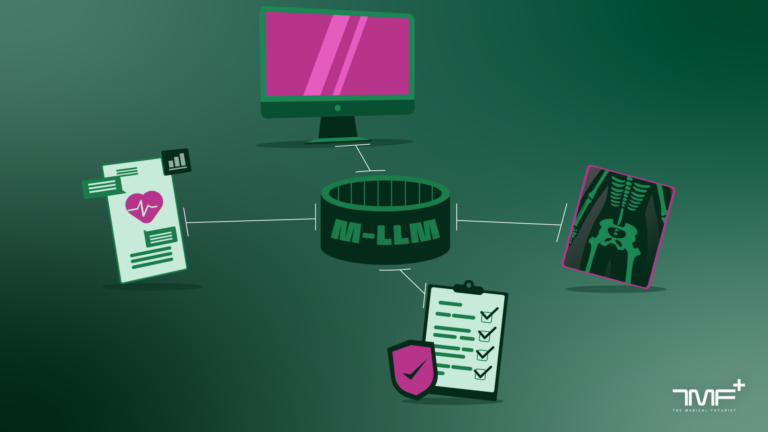
Healthcare contains enormous amounts of information: medical records, laboratory results, imaging, genomics, sensor data, clinical guidelines, scientific literature and population-level datasets. Historically, every source came with its own database, software platform and interface. Humans had to learn how to interact with all those systems.
Large language models begin to reverse that relationship. The software learns how to interact with us.
A patient can ask questions about medical information in natural language. A physician can increasingly interact with several streams of clinical information through one interface. A researcher can interrogate large bodies of scientific literature. A policymaker could eventually explore complex healthcare-system data in much the same way.
Multimodal models make this even more important because the interaction is no longer limited to text. Images, laboratory values, sensor signals and medical records can increasingly become part of the same conversation.
4. Trust in AI decides what we deliver to it
One of the biggest challenges for medical AI will be making it trustworthy enough for people to actually use it.
Think about an MRI machine. A physician does not need to understand every detail of the physics, engineering and software that make an MRI scanner work before using its images to make clinical decisions. They trust the technology because it has gone through validation, regulation and years of clinical use. They know what it is designed to do, where its limitations are, and when its output can be relied upon.
That is the metaphor I find useful for thinking about AI.
We often assume that physicians will trust AI only if they can understand exactly how an algorithm arrived at a conclusion. But that is not how trust works with most medical technologies. We do not open up an MRI scanner and examine its inner workings before accepting the image it produces.
What matters is whether there is sufficient evidence that the system works, whether it has been validated for the situation in which we are using it, whether its limitations are understood, whether there is appropriate regulatory oversight, and whether responsibility is clear when something goes wrong.
5. We cannot have powerful medical AI without losing our privacy
AI is only as useful as the data we allow it to work with. In healthcare, that means medical records, laboratory results, imaging, genomics, sensor data and potentially years of highly personal health information.
This creates an uncomfortable trade-off. We understandably want perfect privacy, but at the same time we want AI systems that understand our medical history, detect patterns across enormous datasets and give us highly personalized recommendations. We cannot maximize both at the same time.
Instead of abandoning privacy, it means moving beyond the unrealistic expectation that meaningful medical AI can operate without access to meaningful medical data. The real challenge is to decide what data we are willing to share, with whom, for what purpose, under what safeguards, and in exchange for what benefit.
The future of medical AI will therefore require more mature conversations about the trade-off between privacy and utility.
The post Five Ideas That Help Make Sense of AI in Medicine appeared first on The Medical Futurist.