HIT Consultant – Read More
What You Should Know
- Suvi Health has officially launched its Ambient AI Care Coordination Platform to streamline hospital stays, improve care continuity, and reduce delayed discharges.
- Created through 1842 Studio (the venture studio of the 1842 Fund, managed by Alloy Partners), the company was co-developed alongside researchers from the University of Notre Dame and clinicians from Mayo Clinic.
- Suvi Health will initiate a four-month pilot site deployment with Mayo Clinic starting in September 2026, targeting heart failure patients admitted through cardiology and internal medicine to tackle length-of-stay (LOS) challenges.
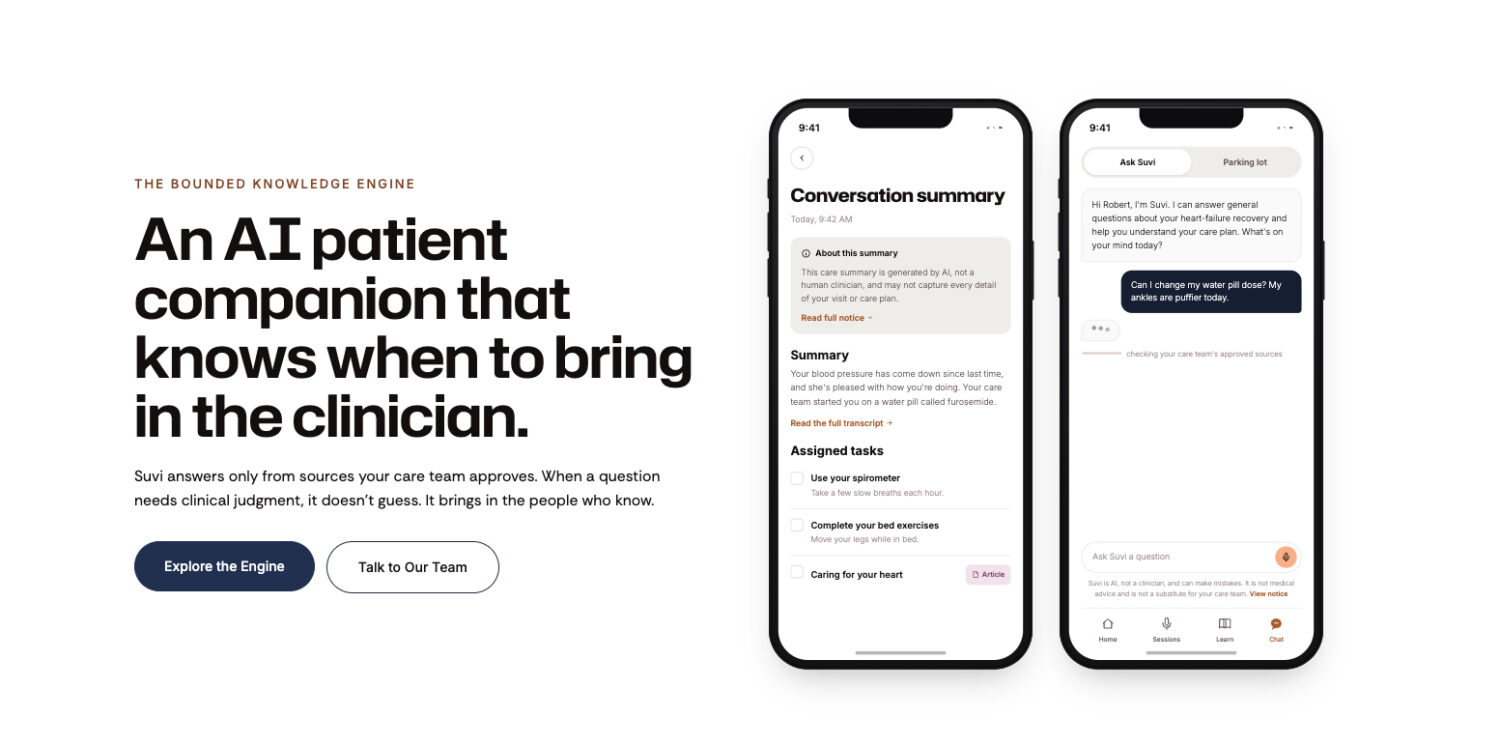
- Unlike traditional physician scribes that require manual toggling, Suvi’s ambient mobile technology automatically detects when a care team member enters the room, capturing bedside discussions to generate shared task lists for care teams, patients, and remote family members.
Closing the Inpatient Handoff Gap
While first-generation ambient AI tools focused almost exclusively on outpatient clinical scribing to ease physician documentation fatigue, Suvi Health targets the acute inpatient care environment—where communication drop-offs between attending physicians, nurses, specialists, and family members directly inflate hospital length of stay (LOS) and trigger preventable 30-day readmissions.
Inpatient care coordination traditionally suffers from extreme information decay. Research indicates patients retain less than 20% of the information communicated during hospital rounding. When complex discharge instructions, medication changes, and daily recovery milestones remain locked in fragmented shift notes, patients and remote family caregivers are left unprepared for post-acute transitions.
Incubated within the 1842 Studio—a joint venture studio framework supported by the 1842 Fund (managed by Alloy Partners), the University of Notre Dame, and Mayo Clinic Florida—Suvi Health addresses this operational bottleneck by automating inpatient dialogue capture and care-plan synthesis:
- Automated Room-Presence Detection: Bypasses manual scribe “start/stop” controls. When deployed on a patient’s mobile device or room tablet, the platform automatically detects when a care team member enters, recording multi-provider interactions (capturing ~17 bedside conversations daily for complex cases) and stopping automatically when they exit.
- Continuous Care Plan Structuring: Distills unstructured conversations involving doctors, nurses, pharmacists, physical therapists, and nutritionists into prioritized daily task lists and plain-language progress summaries.
- Remote Caregiver Activation: Connects distant family members into the patient’s recovery trajectory, providing real-time visibility into discharge requirements (e.g., incentive spirometer use, low-sodium dietary restrictions, or mobility targets).
- Low EMR Friction Architecture: Designed to operate as a light-touch ambient layer, minimizing heavy EMR integration barriers while maintaining HIPAA compliance and two-party consent protocols.
“At its core, Suvi Health’s core principles are about fostering trust and understanding at moments when they matter most,” said Kelly Benning, CEO and Co-Founder of Suvi Health. “When healthcare teams are stretched thin and families are overwhelmed, we believe technology should step in, quietly, to listen, support and help everyone move forward together toward healing and home.”
Clinical Co-Creation & Initial Deployment
The platform’s technical architecture and consent workflows were co-developed through a year-long research collaboration uniting Notre Dame researchers and Mayo Clinic Florida clinicians. Mayo Clinic Florida serves as the platform’s primary co-development partner and initial pilot site, targeting high-volume, chronic heart failure admissions across internal medicine and cardiology service lines to demonstrate measurable LOS reduction.