HIT Consultant – Read More
What You Should Know
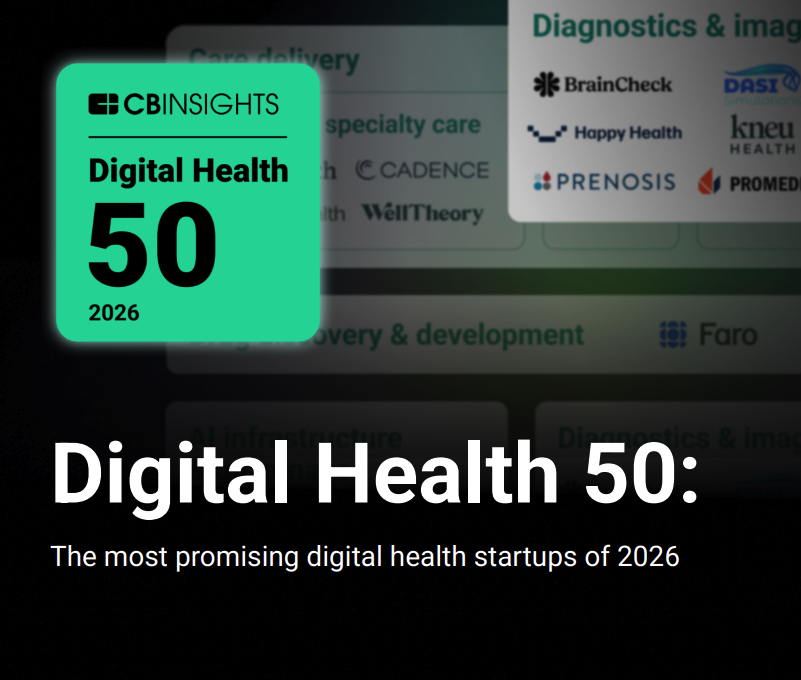
- CB Insights published its eighth annual Digital Health 50 ranking—in partnership with HLTH—selecting 50 top private startups (pre-seed through Series C) from a global pool of more than 50,000 digital health companies using Mosaic Scores, Commercial Maturity ratings, deal activity, partnerships, revenue, and executive interviews.
- Collectively, the 2026 Digital Health 50 cohort has raised $3.5 billion in equity funding (including $2 billion in 2026 alone), disclosed 91 enterprise partnerships since 2025 with leaders such as Mayo Clinic, Siemens Healthineers, and Merck, employs more than 6,000 people (median headcount of 85), and ranks in the top 10% of private companies globally by Mosaic Score.
- Notably, original 2026 winner Counsel was removed from the final ranking after Oura announced on November 10, 2026, its agreement to acquire the company to pair consumer wearable health data with on-demand medical care.
Care Delivery and Administrative Automation Anchor the Cohort
CB Insights mapped the 50 winners across eight core functional categories, reflecting an industry sharply bifurcated between expanding direct clinical capacity and dismantling operational overhead:
- Care Delivery (11 Winners): The single largest category on the 2026 list, spanning chronic and specialty care (9am Health, Cadence, Salvo Health, WellTheory), primary and home care (Adaptive Innovations, Doctronic, General), behavioral health (Amae Health, Birches Health), fertility (Gaia), and longevity (Cent).
- Administrative Operations (8 Winners): Encompassing medication access and pharmacy (Forus, Latent, TJM Labs), billing and practice management (Archy, Stedi, Translucent), and value-based care support (Chamber, Honest Health).
- Diagnostics & Imaging (8 Winners): Featuring clinical tools accelerating cognitive screening, radiotherapy planning, and diagnostic precision, including BrainCheck, DASI Simulations, Gestala, Happy Health, Kneu Health, Oncosoft, Prenosis, and Promedius.
- Clinical Workflow Automation (5 Winners): Including Azra, Hellocare.ai, Sage, Telepatia, and Triomics.
- Patient Communication & Engagement (5 Winners): Comprising Assort Health, Courier Health, Prosper, Tucuvi, and Vocca.
- Drug Discovery & Development (5 Winners): Highlighting AI-driven biopharmaceutical platforms Faro, Galux, Noetik, Proxima, and Remepy.
- Health Insurance Solutions (4 Winners): Including Codoxo, Cohere Health, Onos, and Yuzu Health.
- AI Infrastructure & Governance (4 Winners): Featuring foundational interoperability and AI compliance platforms HealthEx, Optura, Qualified Health, and VegaHealth.
Notably, 26 of the 50 winners focus on eliminating administrative work—from insurance approvals to patient coordination—that diverts clinician time away from direct care.
Three Defining Themes Shaping 2026 Digital Health Innovation
1. AI Is Transitioning from Clerical Assistant to Supervised Care Provider
Rather than restricting artificial intelligence to ambient note-taking and back-office paperwork, leading startups are deploying clinician-supervised AI agents to execute front-line clinical tasks—assessing symptoms, monitoring chronic disease vitals, and recommending prescription renewals. Doctronic pairs AI symptom assessments with virtual physician care; despite regulatory scrutiny over its Utah prescription-renewal pilot, company-reported data indicates physicians agreed with 91 percent of AI-recommended renewals. Cadence deploys clinician-supervised AI agents to monitor patients and manage medications, expanding its senior-care footprint through an April 2026 partnership with Memorial Hermann. Meanwhile, Tucuvi’s voice AI agent, LOLA—the first voice AI in Europe to secure Class IIb medical device certification—conducts automated clinical follow-up calls and escalates acute concerns across more than 10 percent of Spain’s public hospitals.
2. AI Agents Are Rebuilding the Medication Access and Pharmacy Pipeline
As specialty and novel therapies grow more complex and expensive, an average of 65 percent of first-year prescriptions across 99 medicines launched between 2020 and 2024 went unfilled due to payer rejections and patient abandonment. Startups are deploying autonomous agents to bridge fragmented workflows across prior authorization, financial assistance, and pharmacy fulfillment. Forus—which raised a $150 million Series C at a $3 billion valuation—coordinates insurance approvals and pharmacy fulfillment free to patients and providers via biopharma sponsorships. Latent automates medication authorizations and appeals, onboarding Cleveland Clinic and AdventHealth in September 2026, while Courier Health links biopharma, pharmacy, and provider support workflows, and TJM Labs scales pharmacy voice and intake automation following its July 2026 acquisitions of Pharmesol and Encore Rx Automation.
3. Specialty Care Is Moving Beyond the Episodic Appointment
Driven by new outcomes-based Medicare payment models, specialty care innovators are shifting focus from initial specialist access to continuous, multidisciplinary management between office visits to prevent avoidable hospitalizations. Chamber enables cardiologists to manage heart failure under value-based arrangements; Salvo Health embeds dietitians, therapists, and nurses into community gastroenterology practices; Amae Health coordinates psychiatry, primary care, and social services for post-hospitalization severe mental illness; and Cadence integrates daily remote monitoring with chronic care management across medical groups accepted into Medicare’s outcomes-based ACCESS model.