HIT Consultant – Read More
What You Should Know
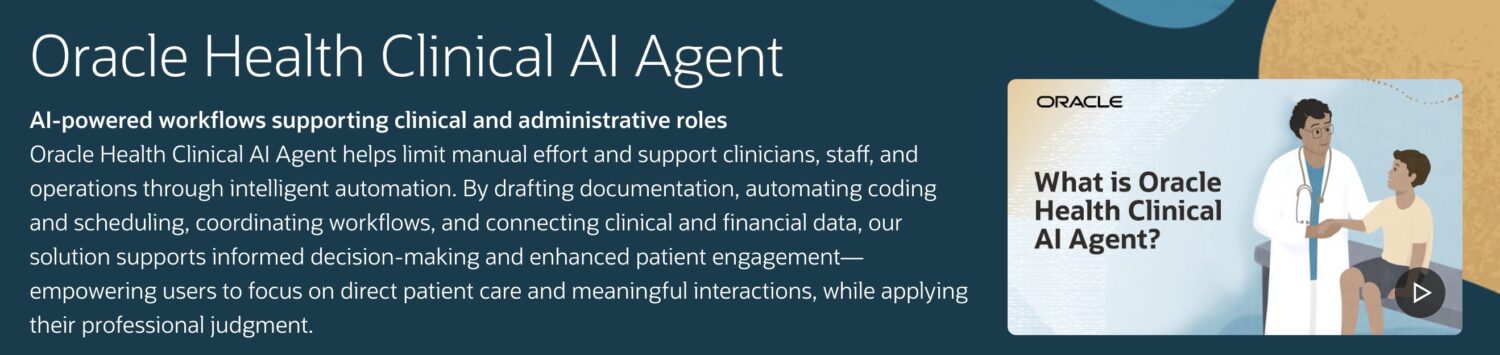
- The Expansion: Oracle Health has officially launched its Clinical AI Agent note generation for inpatient and emergency department (ED) settings across the U.S.
- The Acute Care Challenge: Unlike standard outpatient visits, the ED and inpatient wards are highly dynamic environments requiring longitudinal data synthesis. Oracle’s agent tackles this by natively pulling triage notes, prior days’ documentation, lab results, and imaging directly from the Oracle Health Foundation EHR.
- The Tech Stack: The agent utilizes semantic reasoning to understand clinical meaning rather than just transcribing text. It supports multiple notes per encounter (like admit and progress notes) and features high-accuracy voice recognition capable of distinguishing between the patient, accompanying caregivers, and multiple clinicians.
- The Hard ROI: The solution has already saved U.S. doctors more than 200,000 hours. New Jersey-based AtlantiCare recently expanded the tech to all of its emergency departments after logging a massive 41% decrease in documentation time in its ambulatory settings.
Taming the Acute Care Workflow
To function in this environment, Oracle’s AI does more than just passively listen. It is deeply integrated into the Oracle Health Foundation EHR. When drafting an ED encounter note, the agent proactively pulls in existing triage notes, real-time lab results, and imaging findings discussed during the visit.
In the inpatient setting, it leverages prior days’ progress notes and overnight events to generate comprehensive draft documentation. Crucially, the system features advanced voice recognition that can accurately distinguish between the patient, their anxious family members, and the multiple consulting clinicians cycling in and out of the room.
“The emergency department is one of the most hectic medical settings and clinicians shouldn’t have to choose between caring for patients and keeping up with documentation in the moments where every second counts,” said Seema Verma, Executive Vice President and General Manager, Oracle Health and Life Sciences.
Tangible ROI at the Point of Care
The operational leverage generated by this agentic approach is already surfacing in health system metrics. Since its launch just over a year ago, the Oracle Health Clinical AI Agent has saved doctors more than 200,000 hours across the U.S.
At New Jersey-based AtlantiCare, the health system logged a staggering 41% decrease in documentation time in its ambulatory settings. That success prompted an immediate expansion to all of its emergency departments.
“When documentation becomes lighter and more intuitive, it changes the dynamic of a shift,” noted Jordan Ruch, Chief Information Officer at AtlantiCare. “Our providers can stay present with patients instead of thinking about the screen.”