The Medical Futurist – Read More
Unless you’ve been extremely lucky, you’ve likely been wounded, be it a knife cut while cooking or a sports injury. To remedy this unpleasant experience, you’ve taken some version of the following steps: clean the wound, disinfect the area, and apply a plaster or bandage. While a common and simple first-aid skill, this wound healing process has existed since ancient times.
Furthermore, there are wound cases, especially chronic wounds that arise from conditions such as diabetes, that can be more severe than one might expect. The 5-year survival rate of patients with chronic wounds is about 70%, which is worse than that of breast cancer, prostate cancer and other diseases. In addition, treating wounds adds to the cost of care, leading to about $28 billion per year in the U.S. alone.
Following the traditional use case, the main function of bandages for acute or chronic wound care has been to protect the injured area from external factors that could worsen the injury, such as dirt, bacterial infection and friction. Over the centuries since the inception of wound dressing, some changes have taken place. These have mostly related to the material of bandages, such as stronger-adhering waterproof ones; but the role of the bandage has retained its passive role.
Being in the digital health era, some upgrades to the traditional bandage would be expected and indeed they are on the way. From cyberskins to bandage-free wound healing, the future of wound care will involve the transformation of the role of bandages from a passive to an active one.
We dive into this upcoming future of wound care in this article, exploring the current innovations and upcoming ones.
The upgraded plaster: zip-up healing
The trusty Band-Aid celebrated its 100th anniversary and it’s with high probability that you relied on one (or a non-branded counterpart) when you had a wound that didn’t require a visit to the ER. Once applied, it would stick onto your skin and you’d leave it on until the wound has healed.
This plaster version has now been upgraded with zip-up wound closure solutions. Like their predecessor, these options are applied onto the wound and come with tiny integrated “zip ties”. You can use the latter to gently pull the wound’s edges together. This innovation first came from ZipStitch and later from Clozex. Nowadays, you can find dozens of similar products on Amazon.
These are great at-home solutions that can be practically used for injuries that would require more than a regular bandage, such as a few stitches. The advantage is that there’s no needles or pain involved.
In addition, these zip-up solutions make for a neat addition in home emergency kits. They offer a helpful solution for wound management when professional medical assistance isn’t immediately accessible, but needed.
Smart bandages: remote monitoring and treatment from a plaster
Being in a technologically-driven era of healthcare, it’s quasi-expected for a “smart bandage” option to exist. Research groups have been working on such solutions for years.
Recent efforts are leveraging health sensors and flexible electronics technology. One comes from a team at Tufts University that is developing smart bandages with the ability for wound monitoring and even delivery targeted treatments.
Another team, at the Keck School of Medicine of USC and the California Institute of Technology are working on a “cyber skin” to help wound healing. Their high-tech dressing aims to provide continuous data on healing and risks of complications such as infections and abnormal inflammation. In addition, this cyber skin will be able to deliver medications or other treatments in real time.
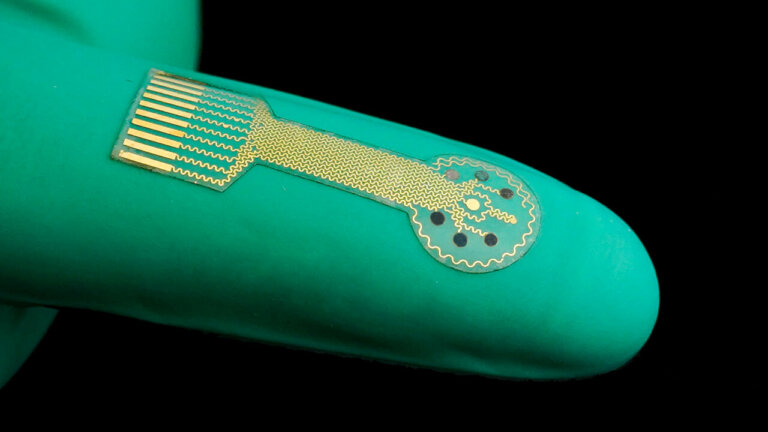
These smart bandage solutions are still in the works and not currently commercially available, unlike the zip-up plasters. However, with active development in such solutions, we could see them emerge in the near future. They can be a huge bonus for remote treatment and monitoring, allowing clinicians to keep an eye on the progress of wound healing and even promote healing from a distance.
Bandage-free wound healing: harnessing the power of electricity
What the two other categories described above have in common is that they both still rely on physical bandages. This can be inconvenient to some, especially when showering or changing clothes. They can also restrict motion and limit daily routines. So how about getting rid of dressings altogether?
This might be a possibility in the future. Researchers have investigated the use of electrical currents to heal chronic wounds. This relies on the electrostatic properties of the human skin, allowing skin cells to respond to electrical fields. Through a controlled electric field around the wound site, the researchers theorise that the healing process will be facilitated via cellular migration.
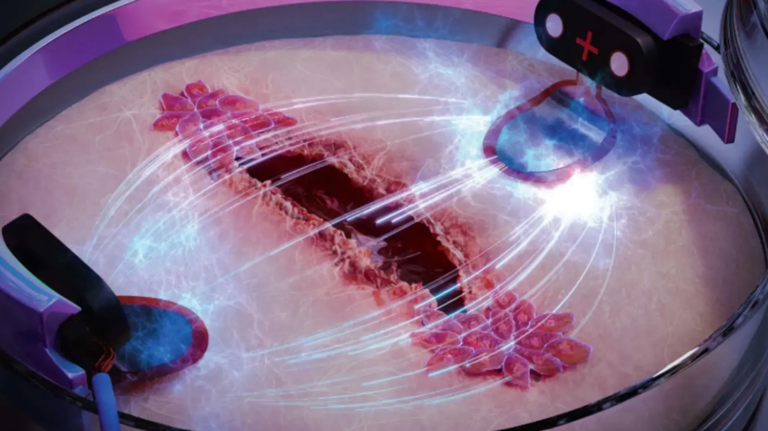
While still conceptual, the use of electricity to heal wounds would be a game changer for patients with difficult-to-treat chronic wounds. It could reduce the painful and cumbersome nature of repeat wound treatment as well as the associated costs.
Overcoming hurdles for an upgraded future of wound healing
There is a promising future for wound healing, but certain hurdles will need to be overcome, while some will likely persist.
Taking the commercially available zip-up plasters, they come with some limitations. For one, they won’t replace the work of a doctor. For wounds under significant tension, the zip-up plasters lack the necessary strength, as a surgeon explained to The Medical Futurist. In addition, they may not offer the same level of precision as traditional stitches. As such, these options might be more suitable for emergency, at-home cases ahead of formal medical evaluation, instead of omitting the latter altogether.
As for smart bandages, they are still years from being commercially available. This is not just because of persisting technical challenges, but also due to financial challenges. Insurance companies will need to be convinced to pay for such options and the way these products are reimbursed need to be ironed out as well. Without financial incentives, such wound healing accessories might not be widely available.
Furthermore, before such solutions become part of regular clinical practice, the standards of wound care will need to be updated accordingly. Most medical systems rely on classic wound care approaches such as visual assessment and classification of wounds without standardised criteria. This can result in inaccurate and unreliable evaluations.
Overcoming such established notions will require significant overhauls, highlighting the importance of the cultural factor in digital health transformation.
Written by Dr. Bertalan Meskó & Dr. Pranavsingh Dhunnoo
The post The Future Of Band-Aids: Current And Future Examples appeared first on The Medical Futurist.