MIT News – Health sciences and technology | Medicine | Health | Health care | Institute for Medical Engineering and Science (IMES) – Read More
3D bioprinting, in which living tissues are printed with cells mixed into soft hydrogels, or “bio-inks,” is widely used in the field of bioengineering for modeling or replacing the tissues in our bodies. The print quality and reproducibility of tissues, however, can face challenges. One of the most significant challenges is created simply by gravity — cells naturally sink to the bottom of the bioink-extruding printer syringe because the cells are heavier than the hydrogel around them.
“This cell settling, which becomes worse during the long print sessions required to print large tissues, leads to clogged nozzles, uneven cell distribution, and inconsistencies between printed tissues,” explains Ritu Raman, the Eugene Bell Career Development Professor of Tissue Engineering and assistant professor of mechanical engineering at MIT. “Existing solutions, such as manually stirring bioinks before loading them into the printer, or using passive mixers, cannot maintain uniformity once printing begins.”
In a study published Feb. 2 in the journal Device, Raman’s team introduces a new approach that aims to solve this core limitation by actively preventing cell sedimentation within bioinks during printing, allowing for more reliable and biologically consistent 3D printed tissues.
“Precise control over the bioink’s physical and biological properties is essential for recreating the structure and function of native tissues,” says Ferdows Afghah, a postdoc in mechanical engineering at MIT and lead author of the study.
“If we can print tissues that more closely mimic those in our bodies, we can use them as models to understand more about human diseases, or to test the safety and efficacy of new therapeutic drugs,” adds Raman. Such models could help researchers move away from techniques like animal testing, which supports recent interest from the U.S. Food and Drug Administration in developing faster, less expensive, and more informative new approaches to establish the safety and efficacy of new treatment paths.
“Eventually, we are working towards regenerative medicine applications such as replacing diseased or injured tissues in our bodies with 3D printed tissues that can help restore healthy function,” says Raman.
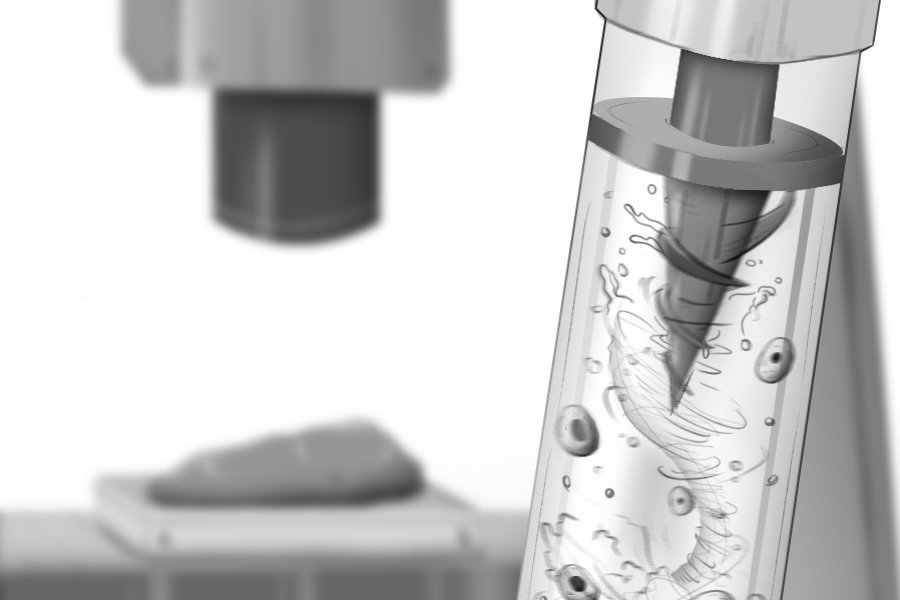
MagMix, a magnetically actuated mixer, is composed of two parts: a small magnetic propeller that fits inside the syringes used by bioprinters to deposit bioinks, layer by layer, into 3D tissues, and a permanent magnet attached to a motor that moves up and down near the syringe, controlling the movement of the propeller inside. Together, this compact system can be mounted onto any standard 3D bioprinter, keeping bioinks uniformly mixed during printing without changing the bioink formulation or interfering with the printer’s normal operation. To test the approach, the team used computer simulations to design the optimal mixing propeller geometry and speed and then validated its performance experimentally.
“Across multiple bioink types, MagMix prevented cell settling for more than 45 minutes of continuous printing, reducing clogging and preserving high cell viability,” says Raman. “Importantly, we showed that mixing speeds could be adjusted to balance effective homogenization for different bioinks while inducing minimal stress on the cells. As a proof-of-concept, we demonstrated that MagMix could be used to 3D print cells that could mature into muscle tissues over the course of several days.”
By maintaining uniform cell distribution throughout long or complex print jobs, MagMix enables the fabrication of high-quality tissues with more consistent biological function. Because the device is compact, low-cost, customizable, and easily integrated into existing 3D printers, it offers a broadly accessible solution for laboratories and industries working toward reproducible engineered tissues for applications in human health including disease modeling, drug screening, and regenerative medicine.
This work was supported, in part, by the Safety, Health, and Environmental Discovery Lab (SHED) at MIT, which provides infrastructure and interdisciplinary expertise to help translate biofabrication innovations from lab-scale demonstrations to scalable, reproducible applications.
“At the SHED, we focus on accelerating the translation of innovative methods into practical tools that researchers can reliably adopt,” says Tolga Durak, the SHED’s founding director. “MagMix is a strong example of how the right combination of technical infrastructure and interdisciplinary support can move biofabrication technologies toward scalable, real-world impact.”
The SHED’s involvement reflects a broader vision of strengthening technology pathways that enhance reproducibility and accessibility across engineering and the life sciences by providing equitable access to advanced equipment and fostering cross-disciplinary collaboration.
“As the field advances toward larger-scale and more standardized systems, integrated labs like SHED are essential for building sustainable capacity,” Durak adds. “Our goal is not only to enable discovery, but to ensure that new technologies can be reliably adopted and sustained over time.”
The team is also interested in non-medical applications of engineered tissues, such as using printed muscles to power safer and more efficient “biohybrid” robots.
The researchers believe this work can improve the reliability and scalability of 3D bioprinting, making the potential impacts on the field of 3D bioprinting and on human health significant. Their paper, “Advancing Bioink Homogeneity in Extrusion 3D Bioprinting with Active In Situ Magnetic Mixing,” is available now from the journal Device.