KFF Health News – Read More
A small Tennessee hospital that was destroyed by a surging river during Hurricane Helene will soon be rebuilt on low-lying farmland that could face several feet of flooding in a much smaller storm, risking another disaster if the new facility is not built to withstand extreme weather, according to a KFF Health News analysis.
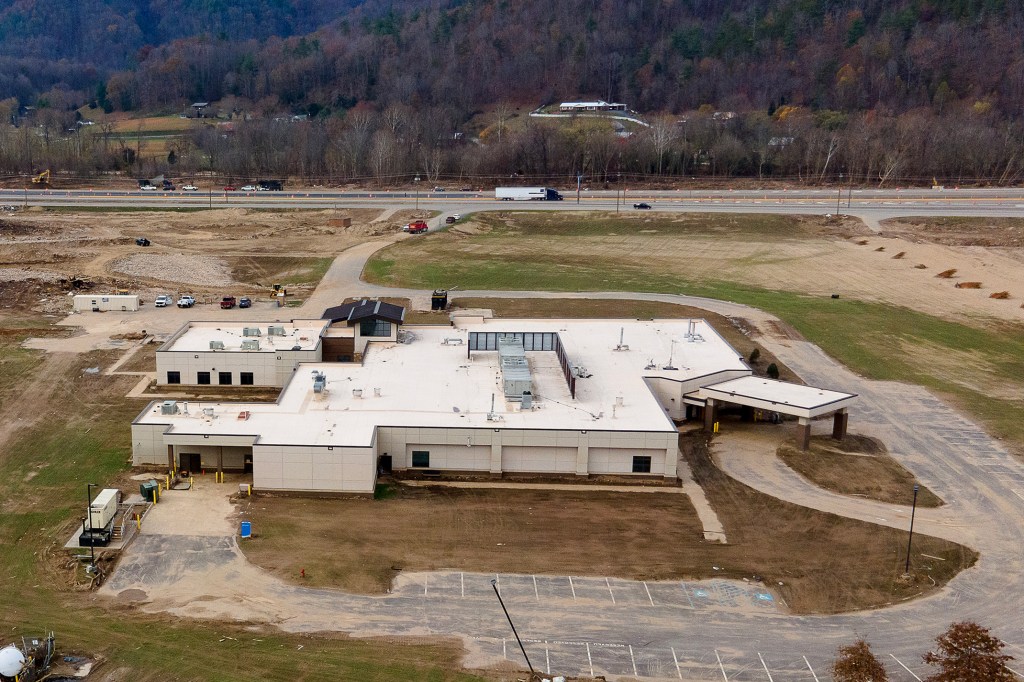
Ballad Health announced in January that it would spend about $44 million to rebuild the 10-bed Unicoi County Hospital in a field behind a Walmart in Unicoi, Tennessee, about 7 miles from the shuttered hospital that was the site of catastrophic flooding and a daring helicopter rescue on Sept. 27, 2024.
But the new location also faces significant flood risk, according to a KFF Health News review of information from Fathom and First Street, two climate data companies whose flood modeling is considered more sophisticated than outdated flood maps published by the Federal Emergency Management Agency. Both Fathom and First Street estimate that a 100-year flood — a weather event more common and less intense than Helene — could cover much of the hospital site with more than 2 feet of water.
“The proposed site is so obviously a flood plain geomorphologically,” said Oliver Wing, chief scientific officer at Fathom. “You don’t need a model to see that.”
Wing said the new hospital site was actually more likely to flood than the old site and “very risky” for development due to a nearby creek and potential storm runoff from mountains to the west. But the flooding would be less powerful than at the old site, Wing said, and its impact could be lessened by elevating the hospital or building earthen embankments.
Ballad Health confirmed the new hospital location but did not respond to questions about flood risk or defenses planned for the site. In a brief written statement, spokesperson Molly Luton said Ballad was working with geotechnical professionals, Zurich Insurance Group, and a high-profile architecture firm in Nashville, Earl Swensson Associates, to “plan and build a safe hospital for the Unicoi County community.” Luton said Ballad is also working with FEMA, which is providing about $7.4 million for the rebuild.
FEMA has served as the nation’s de facto authority for estimating flood risk for half a century, and its flood maps generally determine which buildings must be designed to withstand a flood. But those maps are often incomplete and do not account for the impacts of climate change. FEMA’s flood maps of Unicoi, last updated in 2008, do not identify the new hospital site as a flood hazard zone.
Nationwide, FEMA maps don’t capture much of the flood risk identified by Fathom and First Street, which use sophisticated computer models and detailed terrain data to create flood simulations that are relied on by major developers, insurance companies, and government agencies. First Street publishes much of its modeling online, while Fathom shared data with KFF Health News through a data-use agreement.
Chad Berginnis, executive director of the Association of State Floodplain Managers, said that while the hilly terrain of northeastern Tennessee may limit Ballad’s options to rebuild, it should not ignore the data from Fathom and First Street or rely purely on FEMA’s maps, which suggest the hospital could be built with minimal flood protections.
If Ballad builds behind the Walmart, Berginnis said, it should follow the latest standards from the American Society of Civil Engineers, which recommend elevating hospitals enough to withstand a 1,000-year flood — like the one caused by Helene.
According to those standards and Google Earth elevation data, that could require earthwork to raise the ground of the Unicoi site by at least 8 feet and as much as 18 feet before construction.
“It’s going to require some elevation, and there is going to be some cost,” Berginnis said. “But, my God, you just lost your dang hospital.”
The destruction of Unicoi County Hospital in 2024 prompted a KFF Health News investigation into hospital flood risk, which used Fathom data to identify more than 170 hospitals across the nation that face the greatest risk of significant or dangerous flooding. Of those hospitals, at least 39 faced circumstances similar to Unicoi’s: Nearby rivers or creeks were predicted to swell beyond their banks and engulf the facility.
Ballad Health, which owns Unicoi and 19 other hospitals in Tennessee and Virginia, is the nation’s largest state-sanctioned hospital monopoly and the only option for hospital care for most residents in a 29-county region of Appalachia.
In a news release announcing the Unicoi reconstruction, Ballad said it was finalizing a land purchase for the new hospital site and expected construction to begin in the spring and last two years. Ballad Health Chief Operating Officer Eric Deaton said the reconstruction announcement was “a long-awaited step toward healing.”
“Rebuilding Unicoi County Hospital is about more than bricks and mortar,” Deaton said in the release. “It’s about keeping care close to home for people who have been through so much.”
Tennessee state Rep. Renea Jones, a Republican whose district includes both the old and new Unicoi hospital sites, praised the reconstruction plan in Ballad’s news release. The release did not mention that Ballad would buy about 15 acres of land for the new hospital from Jones’ family, which was first reported by local television station WJHL and later confirmed by Tennessee public records.
Jones did not agree to be interviewed about the sale of the property or its flood risk.
The destroyed Unicoi County Hospital, which cost $30 million, was built along a bend of the Nolichucky River even though FEMA had labeled that area a flood zone for decades. Mountain States Health Alliance began construction in 2017, then later became Ballad Health, which opened the hospital in 2018.
Alan Levine, who was the CEO of Mountain States and now leads Ballad, told KFF Health News in a 2024 interview that Mountain States was aware of the flood risk when Unicoi was built but believed levees could protect the facility.
“I feel like everything we did when we built it was done the right way,” Levine said.
Helene proved too much to handle. As the hurricane carved a deadly path across Southern states and into Appalachia, heavy rainfall caused the Nolichucky to overspill its banks and engulf the hospital in as much as 12 feet of water.

Floodwater pushed inside the hospital and cut the power, forcing patients and staff to evacuate to the roof in hopes of rescue. Ultimately, helicopters plucked 70 people from the roof and the rushing water, narrowly avoiding fatalities.
Angel Mitchell, a Unicoi survivor who was airlifted to safety with her ailing mother, said she was appalled that the hospital would be rebuilt in an area vulnerable to another flood.
But the worst part, Mitchell said, was that locals would have little choice but to tolerate the risk because of Ballad’s monopoly.
“It’s ridiculous,” Mitchell said. “We want to go somewhere to heal, not somewhere to worry.”
KFF Health News is a national newsroom that produces in-depth journalism about health issues and is one of the core operating programs at KFF—an independent source of health policy research, polling, and journalism. Learn more about KFF.
USE OUR CONTENT
This story can be republished for free (details).