
HealthPopuli.com – Read More
Trust is a key enabler for people’s health engagement. As the American Medical Colleges’ Center for Health Justice defines it, trustworthiness is “rooted in honesty and honors lived experience….. key to a successful patient-provider partnership.”
In his book, Notes On Being A Man, Scott Galloway calls out that men’s fertility issues are formed as part of a larger societal context and crisis point, exacerbated by economic pressures and lack of opportunities for male bonding and in-person social touchpoints.
In the second post in this series of three, we discussed those economic pressures Galloway notes, and the financial stressors that shape men’s mindsets about their fertility journeys. In this third of three posts analyzing data from the Progyny Men’s Health survey, we focus on men’s mindsets on trust, trusted messengers for health information, and the influence (for better and worse) of social media.
I collaborated on this research from its initial brainstorming to the analysis of insights shared by men who participated in the study. This is the third of three posts I’m writing to discuss the new research from Progyny exploring men’s experiences with and views on fertility. The survey was conducted among 1,003 men in the U.S. (ages 18-55) in June 2025 among two sets of men: those who conceived or had tried to conceive, and those who had not yet tried to conceive but envisioned it in their future.
Men and fertility literacy, information sources, and social media. The top source of information on fertility among men who have conceived or tried to conceive is a primary care doctor or nurse, for 7 in 10 men. In second place of favorite fertility information resource are specialists, such as urologists and reproductive endocrinologists, tied with general online search engines (e.g., Google).
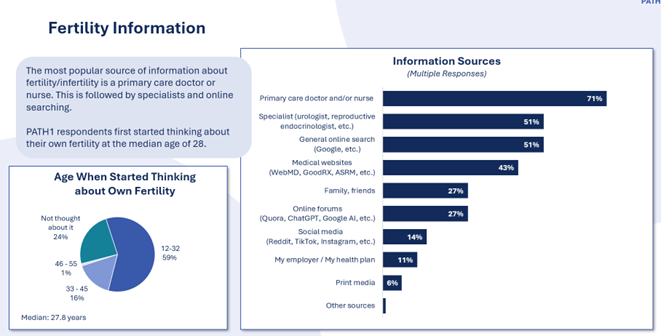
Medical websites are used by 43% of men, followed by family and friends and online forums with 27% of men referring to these sources. Note that employers and health plans are infrequently used, representing an opportunity to grow support (and trust) from and with these organizations.
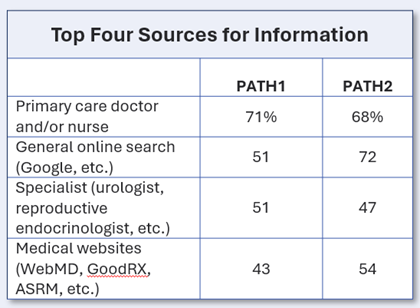
Note differences in favored fertility information sources vary by men who have conceived (PATH 1) or tried to (PATH2), compared with men who have not: those guys on the conceiving-journey tend to favor clinicians as sources of information compared with men who have not had conception on their mind. The latter favor general online search and medical websites, and not clinical professionals.
Social media as a fertility information source was cited by only 14% of our men on the conceiving journey (PATH1). This ranked far below the information source of clinicians (primary care and specialists alike), general online search and website, online forums, and family and friends.

More granularly, only 11% of men with conception on the mind would rely primarily on social media. The mainstream consensus among conceiving-men is that they would “occasionally” check into social media as a fertility information source – instead “would mostly trust” medical professionals. Even the youngest cohort of men in our study would most rely on medical professionals as a reliable information source.
While considered convenient and accessible (an opinion shared by 66% of conceiving-minded men), most men in this group also believe social media often provides misinformation, lacks credibility and verification, and contributes to anxiety and depression.
While those that are older have less positive impressions of social media, men across all ages seem to understand that social media isn’t altogether trustworthy.
However, it is important to call out the role that social media can play in providing and supporting community among men seeing fertility information and broader access to information. This feeling is particularly strong among younger men with conception on the mind. It is encouraging to see men’s relationship with and understanding of social media maturing toward a balanced approach — critical of misinformation, but welcoming trusted sources and the ability to find peer support and empathy in networks.
Trust as enabler for men’s health engagement. Trust is an enabler for health engagement for all people, men and women alike. So it is humbling for health care industry stakeholders to face the fact that peoples’ trust in institutions has eroded over the past decade, as Edelman has perennially tracked in the firm’s annual Trust Barometer
While the level of Americans’ trust in the health care industry overall has held up across the sector, trust with certain segments has eroded – especially for health plans, hospitals, and pharmaceuticals.
But peoples’ trust in the front-line health care professional continues to be strong: in 2025, nurses, pharmacists, and doctors rank in the top five of Gallup’s list of most-honest and ethical professions in the U.S.
For men on the fertility journey, bolstering that trust is crucial as clinicians rank high as information sources (and ultimately, as clinical partners in conception as men choose to collaborate on solutions).
Men on their conception journeys also tend to trust academic medical centers and research organizations like the Mayo Clinic, as well as advocacy organizations such as the American College of Obstetricians and Gynecologists (ACOG) and American Urological Association.
There is an opportunity for improving trust with employers: our research found a deficit of trust among men vis-à-vis their employers: only 21% of conceiving-minded men are likely to trust their employer for fertility information.
However, the Edelman 2025 Trust Barometer continues to find consumers’ relatively high trust with employers – which in the U.S., are the main source of health insurance security for working-aged people.
Leveraging the villagers of trust. With employers the most trusted institution among consumers, and clinicians – nurses, doctors, and pharmacists – scoring high on honesty and ethics compared with other professions – we have the touchpoints to leverage to build a village of trust for men and their sources of truth for fertility information, services, and support.
For employers, fertility and family-building benefits are highly-valued by workers. Four in 10 U.S. employers offered fertility benefits in 2024, up from 30% in 2020, SHRM found, These benefits are, “a positive way for employers to create a more inclusive workplace ,” SHRM reported. Furthermore, providing financial assistance for family-building can further a company’s attractiveness as an employer, as well as an inducement as an attractive employer and bolster worker retention.
The trust-bond between health consumers – patients – and their personal clinicians continues to hold over time. In the current moment of lack of trust in media, government, and NGOs, the trust equity in consumers partnering with clinicians is even more powerful.
The physician- and employer-as-messenger and front-line of care is a powerful source of trust. Supporting clinicians working in fertility, and their relationships with patients through solid information and digital health innovations. helps address the negative aspects of social media and lack of social cohesion for men, their partners, and their very personal fertility journeys.
To explore the Progyny Men’s Health Survey data more fully, check out blog post #1 in this three-part series discussing men feeling overlooked and under-served in their fertility journeys. And here’s a link to blog post #2 on the home economics and financial challenges of family-building and fertility.
The post Men’s Fertility Feelings – The Influence of Trust and Social Media (My Progyny Post #3) appeared first on HealthPopuli.com.