
HealthPopuli.com – Read More
Cost is a leading reason why people say they could not obtain the fertility care they need. But the costs of IVF and other forms of fertility care lie within a larger home economics framework of family-building and -raising. 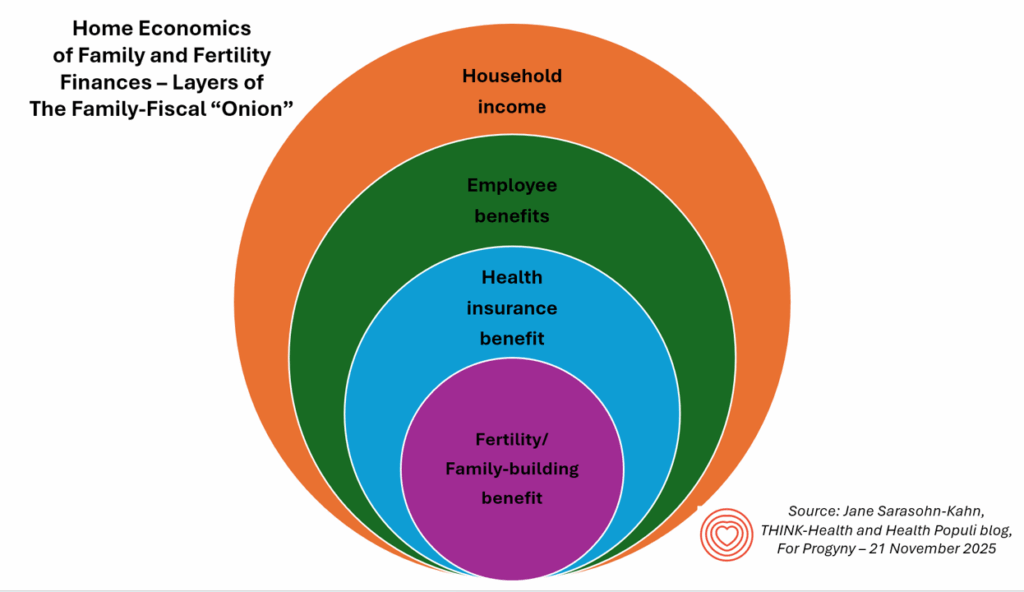
The context and costs of raising a child in America. Consider the layers of a household budget starting with the home’s “macro”-economics of income. Then within that circle, especially in the U.S., the factor of whether that household is covered by employer-sponsored health insurance. The next layer of more health micro-economics in the family is the health insurance plan’s design and, ultimately, coverage for fertility benefits.
Northwestern Mutual recently asked, “How much does it cost to raise a child?” Their bottom-line: that raising a child in 2025 could cost about $320,000 from the time they’re born to age 18 based on government data adjusted for inflation.
Here are the sobering statistics on the cost of raising a child in this video from Northwestern Mutual.
“Having kids can be an incredibly rewarding experience. And as any parent will tell you, it’s also an expensive one,” the insurance company commented. “From pregnancy and childbirth costs to everyday expenses like food, clothing and extracurricular activities, growing your family can come with a steep price tag—and that doesn’t include big-ticket items like college,” they added.
The pie chart shown above from the company’s analysis breaks out those child-rearing costs from birth to age 18. The annual cost of raising a child in America translates to over $17,000 a year, depending on a family’s lifestyle and home location.
Focusing on health care and child care costs. Focusing on the line-items of health care and child care, we quickly tally these together add to $1 in every $4 of the family budget.
“Health care and child care costs contribute to the unsustainable and growing cost of raising a family in America.”
That’s the title of a report from the U.S. Office of the Assistant Secretary for Planning and Evaluation (ASPE), part of the Department of Health and Human Services. (The link to the report is currently disabled due to the U.S. Department of Health and Human Services’ work on the ASPE website).
“The cost of raising a family in America is high and continues to rise, with inflation rising by 23 percent between 2020 and 2025. For working families, some of the largest nondiscretionary expenses continue to be health care and child care,” ASPE points out in the report.
These high costs can be disincentives for families considering having and raising children: ASPE notes lower birth rates in the U.S. which fell over 20% since 2008.
With the annual price of child care for one child ranging from $5,000 to $18,000 in 2025, families can spend , that price equates to over 20% of median family income over a year (at the high-end, based on about $85,000 median family income in the U.S. in 2025 and depending on geographic market.
Add in the cost of fertility treatment as part of a family’s household budget. While there is growing adoption of employer-sponsored fertility benefits coverage, too many individuals/couples still find themselves paying out of pocket to start their family. That translates not only to the cost of coverage, but without the proper plan design, fertility pathways, and trusted clinical relationships, unnecessary costs can accrue when women and families don’t have the benefit of receiving personalized care that is best for them. For instance, according to Fertility IQ, most IVF patients fail on their first cycle and tend to continue treatment for a second, third, or fourth cycle. With IVF costing a range from $20,000 to over $25,000 per cycle, the average patient can accrue over $50,000 in treatment costs. Contrast that to data from one fertility provider that shows care models matter, and can lead to industry-leading results including less treatments and healthier pregnancies. 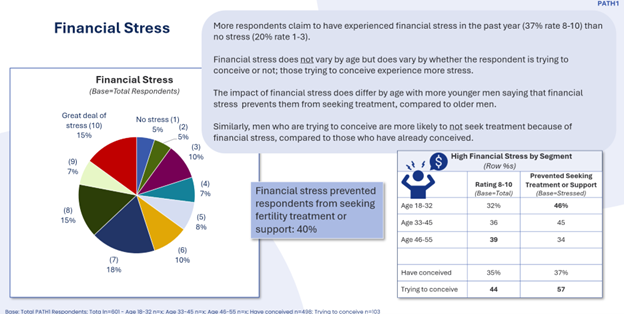
Finance and fertility: the role of cost and care. First, consider conception-minded men’s feelings of financial stress: the Progyny survey conducted among over 1,000 U.S. men found that 37% of these men rated their financial stress on the high end, between 8 and 10 on a scale of 1 to 10. Among those men trying to conceive, 57% were facing high financial stress which prevented them from seeking treatment or support.
High levels of financial stress ranged from 32% in the youngest age group 18-32 compared with 39% among the oldest cohort age 46-55. However, there was an inverse relationship by age when it came to the financial stress preventing men from seeking treatment or support: nearly one-half of younger men 45 and under said the financial stress prevented them from seeking treatment versus 34% of men 46 and over who sought support for their fertility issues. For urology care, the misconception of costs can be unnecessarily driving costs further. Initial screening visits can be just a few hundred dollars, and some fertility health benefits like Proygny include men’s health within the coverage.
Costs come in different forms. There are many kinds of costs that can be barriers for men seeking fertility support. As noted at the start of this post, the top-line retail cost of ARF is a sticker-shock realization for most people following up a diagnosis for fertility care. Always ask your employer if you have coverage.
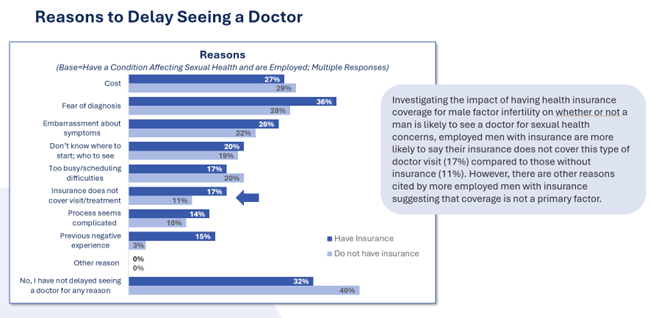
There can also be an emotional cost some men bear – in this case, looking at reasons men delay seeing a doctor, comparing those men with and without health insurance. Fear of a diagnosis was the top-ranked reason insured men gave for delaying seeing a doctor, well beyond cost.
But for men without health insurance, cost trumps all reasons for delaying seeing a doctor, with fear of the sexual health diagnosis a close-second rationale for not seeing a doctor. Taboo/embarrassment about symptoms ranked higher for health-insured men than for those without a health plan.
Being too-busy and having scheduling challenged ranked more challenging as a reason to delay seeing a doctor for men without health insurance than for the insured fellows. These are the time costs that get in the way of people seeking health care when challenged with getting to the workplace, childcare duties, and other responsibilities requiring time spent on a man’s daily schedule.
So while cost is a barrier to seeking care, there are a variety of reasons – including taboo and embarrassment, and the busy-ness of life – that can be barriers to conception-minded men facing friction on the fertility journey.
A majority call for health insurance to cover fertility treatments. One source of dissatisfaction that may contribute to conception-minded men’s lack of trust with employers as a fertility information source could be (lack of) access to fertility benefits and/or (high levels of) cost-sharing for fertility health care. 
Most Americans (61%) say health insurance should cover the cost of fertility treatments, according to a Pew Research Center study. Only 14% of U.S. adults said that health insurance should not cover these treatments, and 1 in 4 people are uncertain whether health insurance should cover fertility care.
While most men and women believe that health insurance should cover fertility services, the share is higher among women than men: 64% compared with 57%. Interestingly, women (47%) are more likely than men (37%) to say they or someone they know has used fertility treatments, indicating a gap in exposure in men’s social networks and/or conversations and media coverage in men’s daily lives.
Stay tuned to Health Populi next week to read my third of three posts discussing the Progyny’s men’s sexual and reproductive health research – with a lens on stress, mental, and social health.
The post The Home Economics of Family and Fertility: Men’s Financial Views on Their Fertility Journeys (My Progyny Post #2) appeared first on HealthPopuli.com.