TIME – Read More
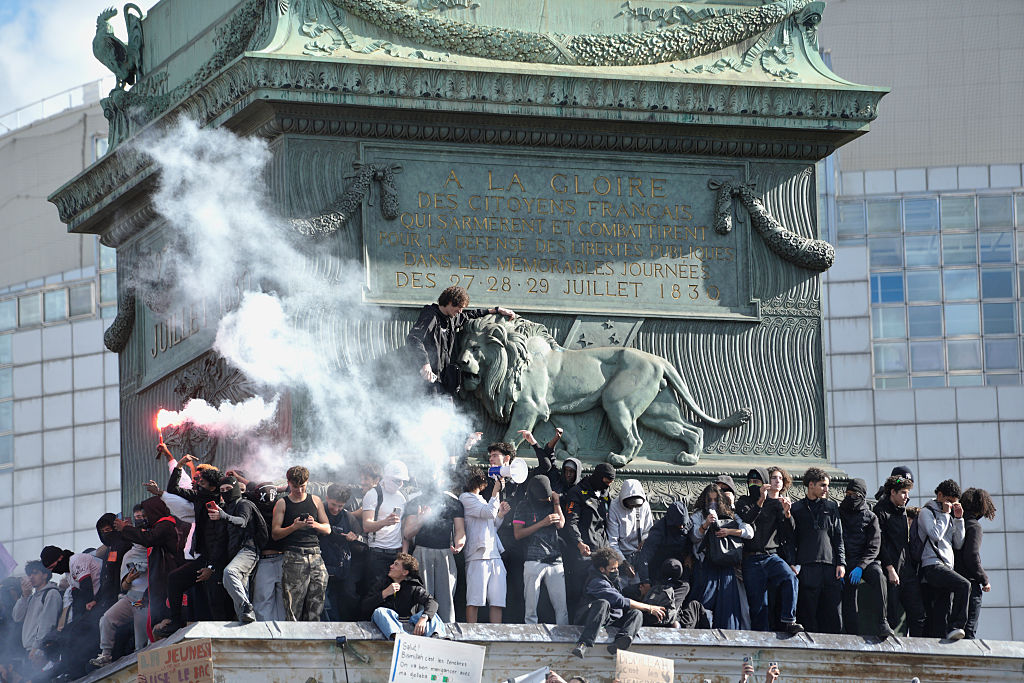
The French like to take to the streets, and they do it often.
On Sept. 17, students at Lycée Saint-Exupéry, a rather underprivileged high school in the Paris suburb of Créteil, erupted in protest over the abysmal conditions of their institution: chronic shortfall of teachers, poor facilities, long declining quality of education. Two weeks later, a wave of protests had swept cities across France. Students from hundreds of schools and scores of universities joined the protests, backed by their parents, teachers, and trade unions. More than 160,000 students and trade unionists protested across France on Tuesday in the third week of demonstrations.
France has never seen so many violent incidents in a movement made up largely of high school students. So far, over 200 students, 85 school staff, and 700 police officers have been injured in clashes across the country. Protesters have broken into schools and, in some cases, set fire to occupied or blockaded buildings. On Oct. 5, a 15-year-old boy had his hand blown off by a police grenade during a protest in Lens in northern France, an incident that crystallized the heavy-handed response authorities had adopted from the earliest days of the protest. More than 6,000 protesters have been arrested, most of them minors, and later released without charge.
The protests erupted after nearly a decade of Macronisme, the right-of-center, top-down governing style that President Emmanuel Macron of France incarnates. And they express a broader discontent: anger over disparities in school quality, university admissions decisions, and latent racial discrimination, and a sense among young people that those in power were not listening to them, that the country offered them little hope for the future.
The protests are also occurring amid a wider crisis of political confidence in the country. France is holding its presidential elections in April 2027, and the far-right and far-left are leading the opinion polls. The frontrunner is Marine Le Pen, who has worked for years to make her far-right party, the National Rally, more electable while campaigning on immigration, crime, and denunciation of an out-of-touch political class. Her party is already the largest opposition party in parliament, and a snap legislative election following the presidential vote could entrench it further.
On the other side is Jean-Luc Mélenchon, the leader of France Unbowed, a far-left party, who is promising a sweeping redistribution of power and resources toward the working class. Both have built much of their appeal on opposition to the political establishment, the promise to wish away budget constraints, and deep hostility toward the European Union.
If France today feels like it is at a crossroads, it is because it is. The postwar model of a large welfare and regulatory state, run by a class of civil servants charged with modernizing the economy, tempering market forces and defining the common good, has run its course.
The collapse of postwar France
France now runs one of Europe’s largest budget deficits: its public debt stands at 119.3 % of GDP and is expected to rise next year. Fears of a crippling financial crisis are growing. Borrowing costs have risen so high that France is drawing comparisons with Greece, whose debt crisis in 2010 threatened the survival of the Eurozone. And with economic growth stagnating, there is no easy way out.
If anything, France would need to spend more: on defense, as Russia grows more threatening, the war in Ukraine continues, and the United States retreats from its traditional role as Europe’s security guarantor; on new technologies, as the country that once produced Concorde and high-speed trains now trails in high-tech innovation and AI; on strained public services, from schools to hospitals to neglected neighborhoods; and on infrastructure capable of withstanding the growing effects of climate change.
Successive French governments have promised to turn things around and allow for these badly needed investments in the country’s future, but none has succeeded.
The French malaise goes deeper. Inequality has been one of the students’ central grievances. They are not wrong. As in many countries, economic inequalities in France have widened over the past two decades under the combined effects of globalization, industrial decline, and the growing concentration of inherited wealth.
In Capital in the Twenty-First Century, the French economist Thomas Piketty showed how wealth perpetuates across generations and widens the divide between those who own capital and everyone else. This concentration of wealth and power remains deeply resented: for many, President Macron’s original sin is still his brief stint at the Rothschild investment bank before entering politics.
But the most injurious form of inequality lies elsewhere: in the power of France’s national meritocratic myth, which holds that people broadly owe their social position largely to their academic performance. At the top of that system sit the highly competitive grandes écoles, the elite institutions of higher education that have produced leaders in politics, culture, and business.
What makes the myth so corrosive is not that academic achievement goes unrewarded but that it remains a pretty reliable path to better jobs, higher status, and positions of power. In such a system, students from underfunded public schools face a profound disadvantage compared with peers who attend better-resourced schools and whose better-educated parents know how to navigate the system.
Private schools offer another route, but are still frowned upon as a way to buy an advantage. It is no surprise that the protests broke out in Créteil, a working-class suburb just outside Paris, where schools are chronically under-resourced.
We shall always have Paris
Racial and geographic discrimination also contribute to the crisis of France. The collection of ethno-racial statistics is prohibited by French law; it is a laudable restriction in principle but problematic in practice. Visible minorities remain vastly underrepresented among France’s political and business elites.
Families with immigrant backgrounds, many with roots in African and Asian countries once colonized by France, are disproportionately concentrated on urban peripheries, where jobs are scarce and residents often face discrimination from employers elsewhere.
Islamophobia has also grown over the last decade amid conflicts in the Middle East and a string of Islamist-inspired terrorist attacks. Rhetoric once largely confined to the far right has seeped into the mainstream right, where calls for “order” and “security” often carry an anti-immigrant charge. Macron’s references to the “decivilization” of some young people and former Interior Minister Bruno Retailleau’s description of immigrants’ participation in the protests that followed the police killing of a teenager in 2023 as a “regression towards ethnic origins” are emblematic of that shift.
There is another problem with France’s meritocratic ideal: Paris. Political power, economic opportunity, cultural prestige, and elite education remain extraordinarily concentrated in the capital. The result is a deep economic divide between Paris and the rest of the country and an elite that lives largely among its own, surrounded by people with similar educations, careers, and assumptions, and cut off from much of the country.
The Yellow Vest revolt of 2018 to 2019 was an earlier social explosion of precisely that resentment. It is hardly surprising that students are denouncing the unequal distribution of resources between Paris and the rest of the country, or that the protests began in Créteil, close enough to the capital for the contrast to be impossible to miss.
When students from my own former school, the elite Lycée Henri-IV, where I was a rather poor student, joined the movement in its third week, I noticed how carefully they described themselves as protesting “in solidarity” with less privileged schools. They knew which side of the divide they were on. So much for meritocracy.
Racing to the Elysée
Where does this leave France? With the presidential elections approaching next April, political parties are scrambling to position themselves in relation to a protest movement that has shown no sign of abating. On Oct. 6, more than a quarter-million people took to the streets as high school students were joined by university students, teachers, parents and trade unions. An even wider “national day of protest” is planned for Oct. 17.
Both familiar and new dynamics will shape the election. The familiar one is the runoff dilemma: voters may once again be asked to support a candidate from the opposite political camp simply to prevent Le Pen from reaching the Élysée. Le Pen made the runoff in both 2017 and 2022 and is leading the polls by a large margin. This time, however, the field trailing her is unusually fragmented. Two former prime ministers under Macron, Édouard Philippe and Gabriel Attal, are in the race; Philippe is competing with Mélenchon for second place, while Attal trails both.
Whatever the outcome, the presidential vote may resolve little. A president from the far-right National Rally could find herself governing without a stable parliamentary majority or broad support among the public or within the civil service. A compromise candidate from the center or left could face the same fractured parliament that has bedeviled the final years of Macron’s presidency, during which France has had five prime ministers in two years.
What is new is the extent to which France is being reshaped by forces now familiar across the globe: a crisis of confidence in democracy, conservative billionaires building media empires and financing ideological movements, polarizing social media, foreign interference in elections, and growing voter distrust of supranational institutions, including the European Union.
France, unlike the United States, places strict limits on campaign spending, but money still shapes the broader political ecosystem. Pierre-Édouard Stérin, a self-described “conservative libertarian,” has committed substantial resources to organizations seeking to advance right-wing and far-right agendas. The industrialist Vincent Bolloré has assembled a vast media empire that includes CNews, a Fox News-style channel that has become an important platform for the nationalist right.
Europe on the line
Whatever the result of the Presidential elections, the outlook is troubling for Europe. A Le Pen or Mélenchon presidency would test European cohesion on everything from Ukraine and relations with Russia to migration, budgets, and the authority of the European Union. But even a more centrist president would likely lack a strong enough coalition to govern effectively, mirroring the current situation in Germany, where Chancellor Friedrich Merz is hobbled by unpopularity and a surge in support for the far-right Alternative for Deutschland.
With France and Germany together accounting for roughly 40% of the E.U. economy, political weakness in both capitals would deprive Europe of its traditional engine at a particularly dangerous moment. Europe faces mounting pressure on three fronts: China’s industrial onslaught, reflected in an annual trade deficit of roughly €360 billion; Russia’s war against Ukraine and escalating “gray warfare” operations; and the American turn against the postwar international order on which Europe has long depended. All this comes as Europe must also prepare for the profound disruptions of climate change and AI.
The remedy laid out by Mario Draghi, famed for rescuing the euro during his tenure as president of the European Central Bank, calls for greater integration of the single market, more investment and industrial consolidation, and a greater capacity to act collectively. France is indispensable to any such reforms. A politically paralyzed France would leave Europe weaker at precisely the moment when it can least afford it.
The revolution still to come
At the heart of the French Revolution of 1789 was the abolition of the privileges of the aristocracy and clergy. Close to two and a half centuries later, privilege remains deeply embedded in French society, dispersed across an array of almost caste-like social and professional groups, from journalists, lawyers, and intellectuals to civil servants and unionized workers, each with its own advantages, protections, pension arrangements, and claims on state resources. The result is a politics in which almost everyone agrees that reform is urgently needed, provided someone else pays, and their own group’s advantages remain untouched.
If this sounds like an overreading of 1789, consider Macron’s own choice of title for the book that launched his presidential bid: Révolution. His presidency may not have proved entirely revolutionary, yet many of his larger prescriptions have aged well: governments around the world have embraced state-led industrial policy, greater strategic autonomy, and reduced dependence on fossil fuels, while distrust of American hegemony and calls for deeper European integration have gained traction as the postwar order fragments.
Macron can also claim some credit for preserving, and in places renewing, France’s traditional strengths: an electricity system powered largely by nuclear energy, global leadership in luxury goods, tourism and hospitality, and a deep reservoir of scientific talent, now exemplified by Mistral, Europe’s closest thing to a world-class AI contender.
A skilled diplomat and relentless advocate for the multilateral system, Macron has also taken principled stands on Ukraine, Gaza, Lebanon, debt relief for the world’s poorest countries, and climate change, while carefully navigating France’s relationships with America and China. France’s permanent seat on the U.N. Security Council gives it diplomatic weight far beyond the country’s economic size, a status French diplomats ironically describe as “flying first class on an economy ticket.”
Yet neither these prescriptions nor these assets have been enough to reverse France’s decline over the past two decades. Perhaps what has been missing is a revolution not so much in policy as in political culture: a new social compact in which the sacrifices required to adjust to France’s reduced means and diminished relative power are accepted because the burdens are seen to be shared fairly. If such a revolution is to come, it is less likely to start in the Élysée or the ministries than among the students in the streets demanding to be heard.
.jpg?branch=production)