HealthPopuli.com – Read More
Three in four licensed psychologists in the U.S. report that their patients have spoken about using AI — with at least one-third reporting use for self-diagnosis, help with self-discipline or behavioral reminders, or as an assist in therapy.
This is the top-line finding in the 2026 Chatbots and Mental Health Survey from the American Psychological Association (APA). This is among the first such study into patients’ use of AI for mental health support.
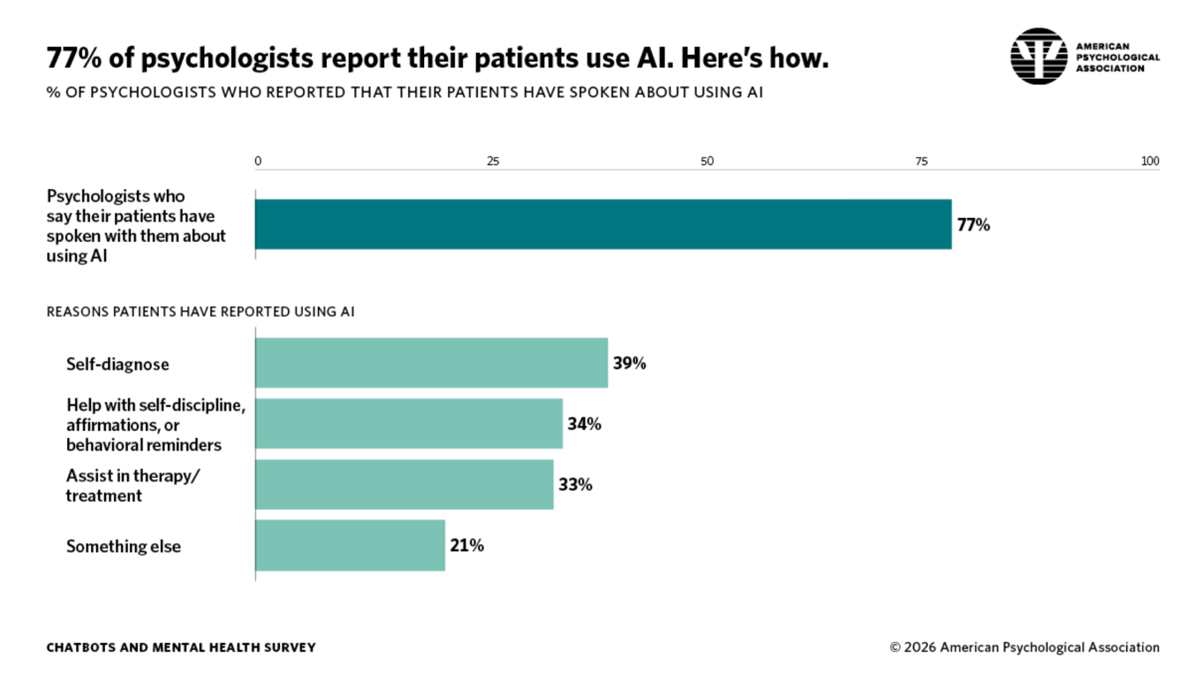
APA conducted the survey among 1,242 licensed psychologists in the U.S. in April 2026,
In this early phase of patients adopting AI in mental health, it’s no surprise that the vast majority of psychologist worry that chatbots may cause unexpected harm:
- 97% believe that chatbots could inadvertently reinforce negative behaviors or dysfunctional beliefs
- 94% worry today’s chatbots cannot treat conditions with an appropriate amount of nuance
- 93% are concerned that using AI to provide companionship that could negatively impact users’ social engagement, and,
- 89% say chatbots may inadvertently encourage self-harm.

Psychologists have already considered positive and negative effects that occur with patients’ use of AI. On the positive front, clinicians call out the good aspect of patients able to accessibly talk about their mental health with a chatbot, patients feeling support or validated by a chatbot, positive communication with a chatbot, and using a chatbot to reinforce healthy living skills.
On the downside, one-third of clinicians are concerned about patients becoming dependent on a chatbot; one-fourth of psychologists worry that a patient could develop unhealthy communication with a chatbot; and 15% note patients could develop distorted thinking or delusions resulting from chatbot interaction.
Most psychologists don’t trust chatbots to follow best practices — concerned that AI assisted therapy will introduce more risks to patients than traditional therapy.
Thus, as this bar chart illustrates, 85% of psychologists worry about chatbots posing as licensed therapists and thus do not believe the technology will ever replace human therapists.
Still, 40% of licensed therapists are optimistic that chatbots will be able to help patients when a professional is not available.
Health Populi’s Hot Points: Among the 35% of licensed psychologists whose patients are already using AI to augment mental health treatment, one-third of those clinicians say patients are engaging with chatbots “for fun,” 22% “for friendship,” and 13% for “an intimate relationship.”

As the convergence of AI/chatbots and mental health matures and develops, and is adopted by under-served patients where therapy is in short accessible supply, we can benefit from APA’s recommendations for finding safe support from AI — emphasizing the importance of “humans in the loop” — that is, real-live mental health professionals where a chatbot can augment traditional therapy.
This list offers the start of APA’s advice, which can be found in full format on the APA’s website.
The post Most Psychologists Say Their Patients Use AI for Mental Health Support – Recommendations on Chatbots and AI from the APA appeared first on HealthPopuli.com.