The Medical Futurist – Read More
AI scribes, the apps that can listen in to the conversations between patients and healthcare professionals and transform them into the exact electronic medical record format the given hospital or practice is using, have taken the healthcare industry by storm. For the past 1-2 years, everyone has been talking about their potential, technical difficulties in implementation and whether patients and their physicians would be open to using it.
The potential advantages are obvious: to take over the administrative burden from physicians. This is simply the lowest-hanging fruit in the entire healthcare ecosystem. Just the idea of reducing the time physicians spend on administration is enough to get the attention of anyone in this industry. Studies have been coming out about this aspect and we analyzed them in detail here.
The downsides would include the complex IT and legal infrastructure behind care that makes it challenging to just implement such a system into any medical practice. Physicians need to ask for consent from patients before using it, and they still have to learn its tricks to really benefit from AI scribes.
Keeping all these in mind, I turned to an established futures method, scenario analysis, to gain some insights about how we might want to think about the near future of this technology. For scenario analysis, you need a key driving force that will have a major impact on how changes unfold in our field of interest; and a major uncertainty that might hinder our chances any time to fully exploit its benefits. I chose the following, based on which, you can see the four scenarios and their short descriptions below.
Key driver: Growing evidence in studies
Major uncertainty: Acceptance by medical professionals
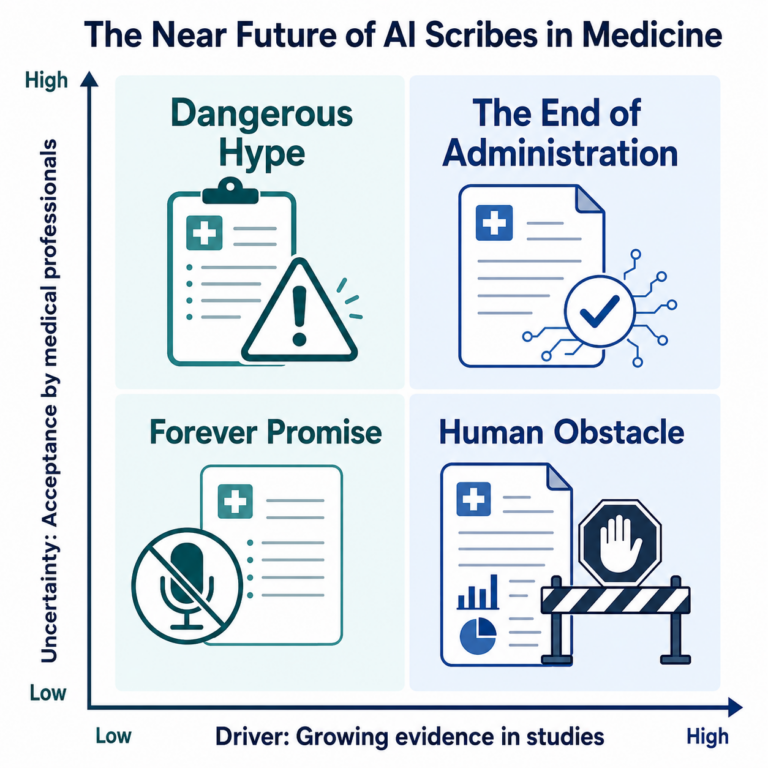
Scenario #1. Dangerous Hype (High acceptance / Low evidence)
Clinicians adopt AI scribes enthusiastically because they promise less administrative burden, better work-life balance and smoother visits with their patients. But the evidence base is still thin: there are studies with varying results. Some show significant time reduction while using the technology, others find nuances only. Therefore, early adoption is driven more by hope, vendor claims and anecdotal relief than proven outcomes. It makes AI scribes a potentially dangerous technology as nothing works without evidence in medicine.
Scenario #2. The End of Administration (High acceptance / High evidence)
AI scribes become a normal part of clinical work. I go further than that:it becomes unimaginable to work without them. Studies show clear benefits in documentation quality, clinician satisfaction and workflow efficiency, while physicians see the tool as background infrastructure rather than “AI magic.” Everyone adopts it and using AI scribes is the new medical norm.
Scenario #3. Forever Promise (Low acceptance / Low evidence)
AI scribes remain a niche tool. Evidence is weak, and it turns out to be just another AI flop. Clinicians therefore remain skeptical, and concerns about errors, privacy, workflow disruption or patient comfort prevent widespread use. And all these for a reason: no evidence, no adoption.
Scenario #4. Human Obstacle (Low acceptance / High evidence)
Studies increasingly show that AI scribes work, but physicians still resist adoption because of trust, liability, patient consent, integration problems, or fear that documentation becomes too automated and less clinically thoughtful. They generally have a trust issue towards AI so only the most enthusiastic physicians keep on using it. Others prefer old methods even if those are slow and burdensome.
Conclusions
What we can derive from these scenarios is that if evidence is not growing behind AI scribes in medicine, there is nothing to talk about. But if it is (and it seems it has been growing steadily), the issue we have to work on now is acceptance and adoption by medical professionals. If they are not on board with a technology that can make their jobs better, we will all fail at implementing it.
So, if a call to action can be summarized, it is that we have to sensitise physicians about AI scribes, otherwise, we will face a long decade of adoption struggles and lag in using an evidence-based and advanced technology for the benefit of patients.
That’s why I publish so many videos and articles about AI scribes for physicians.
The post Four Scenarios of AI Scribe Adoption in Healthcare appeared first on The Medical Futurist.