The Medical Futurist – Read More
Dear physicians, let me ask you a simple question.
When did documentation become a bigger part of medicine than actually talking to patients?
I know. You have heard about AI scribes. You have probably watched explainer videos about what they are, how they listen to the consultation, how they turn the conversation into a structured note, and how they promise to reduce your documentation burden. Maybe you even watched mine.
But you still have doubts. That is healthy. In medicine, doubt is not a weakness. It is a professional reflex. You should question any technology that enters the clinical encounter, especially one that listens to a conversation between a patient and a physician.
But here is the point I think we should not miss: AI scribes are not really about AI. They are about giving attention back to patients. That is why I think they might become one of the first healthcare AI tools physicians genuinely want to use.
Because no physician became a physician to become a documentation machine
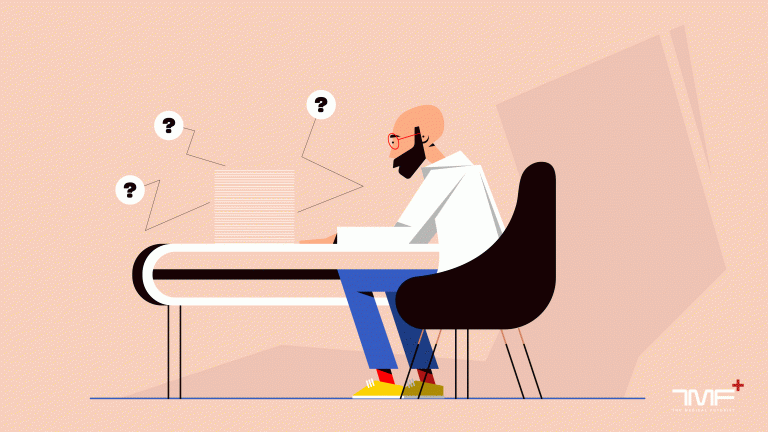
The administrative burden in medicine has become absurd. In one well-known time-motion study in ambulatory care, physicians spent only 27% of their office day on direct clinical face time with patients, while 49.2% went to EHR and desk work. In the examination room itself, more than a third of the time still went to EHR and desk work.
This is not why people enter medicine. Medical students do not imagine their future careers as a life of clicking boxes, retyping patient stories into templates, and finishing notes after hours. Yet many learn early that modern medicine often means splitting attention between the human being in front of them and the screen beside them.
And patients feel it too. They can tell when we are present. They can also tell when half of our mind is already preparing the note, checking the medication list, or wondering how much documentation is still waiting at the end of the day.
The first argument for AI scribes is that the current situation is unacceptable.
Because the computer should not be the third person in the room
The exam room should belong to the patient and the physician. Of course, documentation is necessary. Good notes matter. Continuity of care matters. Legal and billing requirements matter. But somewhere along the way, the computer became too dominant in the clinical encounter.
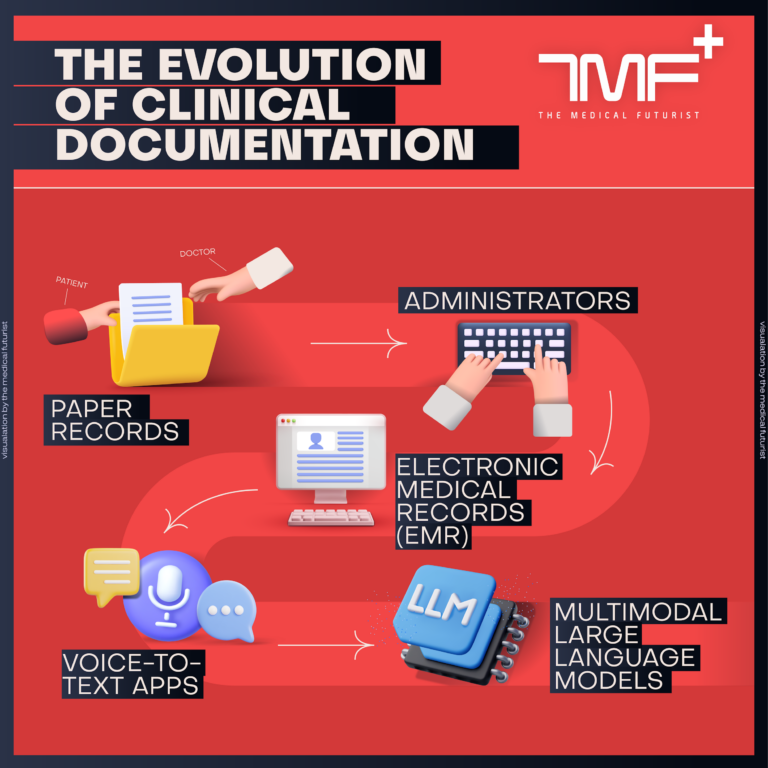
AI scribes offer a different model. Instead of typing while the patient speaks, the physician can listen. Instead of translating the conversation into documentation in real time, the physician can focus on the patient’s concerns, emotions, questions and hesitations. The AI scribe drafts the note in the background, and the physician reviews it afterwards.
That distinction matters. The best digital health technologies are the ones that make medicine feel more human again.
Because mistakes are not a reason to reject them: they are a reason to supervise them
Yes, AI scribes make mistakes. They can misunderstand a phrase. They can omit something relevant. They can over-structure a messy conversation. And yes, like other generative AI tools, they can hallucinate.
This is exactly why no AI-generated note should go into the EHR without physician supervision. But human documentation is not perfect either. Human scribes make mistakes. Assistants make mistakes. Physicians make mistakes. The difference is not whether errors exist. The difference is whether the workflow is designed to catch them.
The physician remains responsible for the note. That means the physician must review, correct and approve the output. It also means healthcare institutions must take consent, privacy, data governance and auditability seriously. Patients should know when an AI scribe is being used. They should understand what is recorded, how it is processed, and what ends up in the medical record.
Because the evidence is moving in the right direction
The early evidence does not show that AI scribes suddenly save every physician two hours a day in every specialty and every setting. But it does show reductions in documentation and EHR time are appearing in real-world settings.
A large JAMA study across five US academic health systems found that AI scribe adoption was associated with 13.4 fewer minutes of total EHR time and 16.0 fewer minutes of documentation time per 8 scheduled patient hours. The effect was modest overall, but real: and stronger in some groups and workflows.
Another large European analysis, involving more than 375,000 medical notes generated by 1,295 clinicians, reported that documentation time dropped from 6.69 minutes to 4.71 minutes per note, a 29% reduction.
Now, we should not oversell this. A few minutes per note may not sound revolutionary. Thirteen minutes less EHR time per day may not feel like salvation to a physician drowning in bureaucracy. But at scale, these minutes matter.
They matter across a full clinic day. They matter across a full week. They matter when they reduce after-hours work. They matter when they allow a physician to look a patient in the eye instead of typing through the visit. And this is still an early version of the technology.
Because AI scribes are only the beginning
The current AI scribe listens to the encounter and drafts a note. That is useful, but the real future begins when documentation tools become part of a broader AI-supported clinical workflow. Imagine this:
While the AI scribe summarizes the visit, another approved AI agent retrieves the relevant previous correspondence with this patient. It checks whether the patient emailed about the same symptom last month. It summarizes the last specialist letter. It identifies pending lab results. It prepares a draft follow-up message in patient-friendly language. It does not act autonomously. It prepares the work for the physician to approve.
Healthcare is full of repetitive, fragmented, low-value administrative tasks. Searching, copying, summarizing, reformatting, re-entering, checking, chasing. These are exactly the tasks AI systems are becoming good at.
So, should physicians get on board?
Physicians should be demanding users of AI scribes. They should test them, challenge them, evaluate them, and insist on safe implementation. They should ask hard questions about privacy, consent, accuracy, liability, integration and workflow.
AI scribes will not fix burnout or solve workforce shortages alone. They will not make broken EHR systems beautiful overnight. But they can be one meaningful step toward a more humane clinical workflow.
This way, AI scribes may become one of the first healthcare AI tools clinicians genuinely want to use: not because they are excited about artificial intelligence, but because they want to spend more time being clinicians again.
The post 5 Reasons Physicians Should Get On Board With AI Scribes appeared first on The Medical Futurist.