HealthPopuli.com – Read More
Like gas and healthcare prices crowding out other spending, the topic of “AI” can crowd out other issues in our email inboxes, LinkedIn and other social media channels, and local and national concerns. Getting my head into John Nosta’s new book, The Borrowed Mind: Reclaiming Human Thought in the Age of AI, could not have come at a better time given AI’s growing presence in my own brain, work conversations, and local political discussions in our community and state.
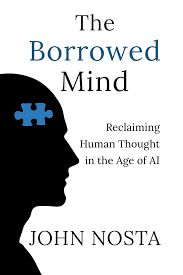
After one read-through, I let John know I would need to do a second reading as I indeed had to reclaim my own human thought and brain energy after the first review of some very challenging content. John didn’t earn the often-used description of being “a digital health philosopher and innovation theorist” for nothing. He’s one of my deepest-thinking colleagues, so the book’s gravitas didn’t surprise me. But challenge me, it surely did.
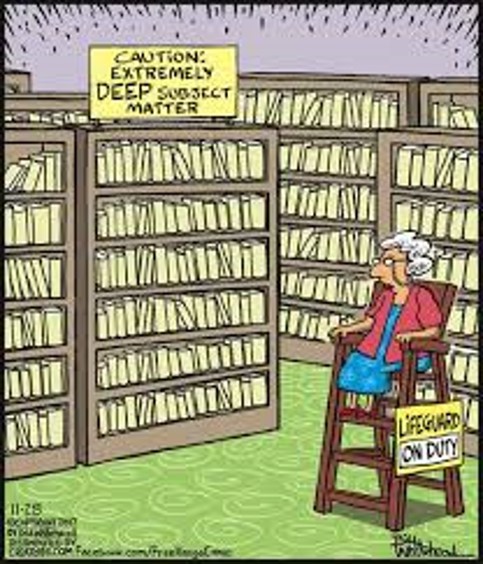
One day during that second go-round into The Borrowed Mind, I happened upon this cartoon which rang true to me in this moment of immersing myself into John’s Extremely “Deep” Subject Matter (cartoon thanks to the witty Bill Whitehead).
Within a day of chuckling with this cartoon, I read Maggie Harrison Dupr
Then there was this study from BCG observing a phenomenon of “AI brain fry” conducted among 1,488 U.S. workers in large companies whose use of AI increased workers’ errors, caused decision overload, and eventually led to employees’ intentions to quit the company.
Between John’s book, Maggie’s essay, and the cartoon, April was my month of getting more sober and educated about AI and health care.
I’ve had my individual discomforts about AI in general (such as the macroeconomic impacts and uncertainties for labor and jobs, local economies vis-a-vis data centers, some research into AI’s output for health care decision making, and the general lack of regulatory guardrails), and other concerns. I’m probably “average” under the current consumer adoption S-curve of concerns with an over-arching “concerned embrace” of AI — welcoming the upsides of the technology while realistically concerned about potential impacts on the patient-physician relationship, health equity, access, and potential for designed-in misuse/abuse.
One of the best aspects of The Borrowed Mind is that John’s artfully written text offers the sort of nuance the topic requires. He covers upsides, downsides, use cases, and the most important lens for my own reading and work, the issues of cognition which cover about one-half of the 200+ pages.
The Borrowed Mind provides a balanced argument on AI’s impact on humans, first describing the overall promise of AI (e.g., as a support for lifelong learning, filling ‘cracks in knowledge maps,’ and medical research opportunities, among other promising use cases). Then we head into “The Perils,” which was the section I consumed most deeply to check my own intuitions and preconceptions as well as enhance my deeper appreciation for the cognitive challenges.
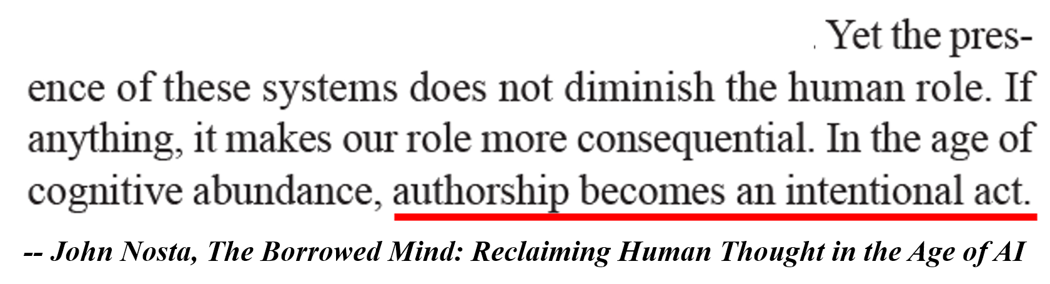
Rounding out this deep, important read is the third section which imagines opportunities to smooth the path to AI adoption, with a heavy dose of arguing for agency — which many of us have been raising in my close-in health care consumerism world — and a fascinating discussion of becoming “authors” of our own minds.
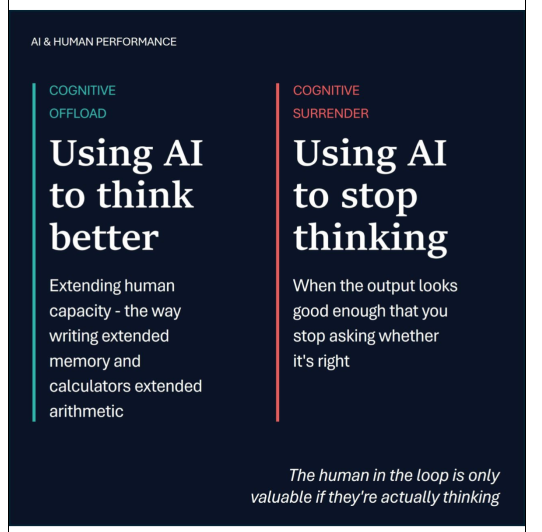
In short, this graphic from a recent post from Novo Nordisk AI leader, Carolina Benjaminsen, portrays the two-sides-of-the-AI-cognition-coin perfectly for me:
“The human in the loop is only valuable if they’re actually thinking.”
We can use AI to “think better.” That’s cognitive offload.
We can use AI to “stop thinking.” That’s cognitive surrender.
In this early go-go consumer adoption era jumping into AI for life and workflows (like health care), AI on-ramps are alluring, accessible channels to conveniently, quickly get information about clinical questions on our minds. That’s absolutely attractive and feels empowering, that quickness of response and seemingly literate advice.
But without motivating and engaging ourselves to be our own best humans in these loops, the AI output and the process by which we generated it can actually slow us down, lead us down holes of bad or hurtful advice, and give us a false sense of Superhuman Agency.
AI isn’t a Superpower on its own, but we can leverage it to help us be smarter humans and keep our brains alive, challenging and sharp.
So I’m thanking John for preventing me from putting my brain on Borrowed status. I’m holding on to it, honing it, and forging my own best practices for using AI if not at a snail’s pace, then something between tortoise-and-hare as a recent Rock Health report differentiated consumers’ quick adoption curves for AI compared with health care industry’s and providers’ use of the technology.
Health Populi’s Hot Points: For some time, I’ve been going offline more of the time….having tasted The Offline Club while living and traveling in Europe, touching base with retreats in Amsterdam, Brussels, and London, and savoring these connections for social health and digital detoxing. I’m doing more “Offline Club” style life-flows on this side of the Atlantic these days.
So the concept of being personally mindful about my own use of AI is propitiously timed for my own work and personal life flows.
The hot topics of longevity and brain health also converge in this moment, coupled with AI and my digital detoxing practices. More of us are hungry and craving moments of personal connection, socializing, and face-to-face fun and joy-making.
I am grateful to John for his long-time collegiality and always-challenging voice in the work that I do. I am grateful he took his time to immerse himself, deeply, in the earliest days of AI and to challenge his own world-view to shape a lane with his unique perspective on how AI will require us to work hard if we choose to get not only more literate with it, but fluent and, ideally, be like Michelangelo with it — to liberate the slave from the stone, to come to those potentially beautiful and powerful ideations and lightbulb moments.
Let not your Brain be Borrowed. Be engaged, be mindful, be keen and critical users of AI. And as John and I both so highly value, take time offline for those family and friend relationships and times to connect alive, live, in person. Nothing artificial or augmented in those moments…just pure joy that promotes Joyspan, a valuable notion for longevity.
The post Will AI Make Our Minds Feel Like Boiling Frogs, Be Borrowed, or Inspire Agency and Joy? Learning from John Nosta appeared first on HealthPopuli.com.