HealthPopuli.com – Read More
Consumers’ spending on healthcare, beyond a health insurance premium and hospital bills, is among the fastest-growing industries in the U.S. — with spending increasing faster than overall retail, Circana’s tracking data has quantified.
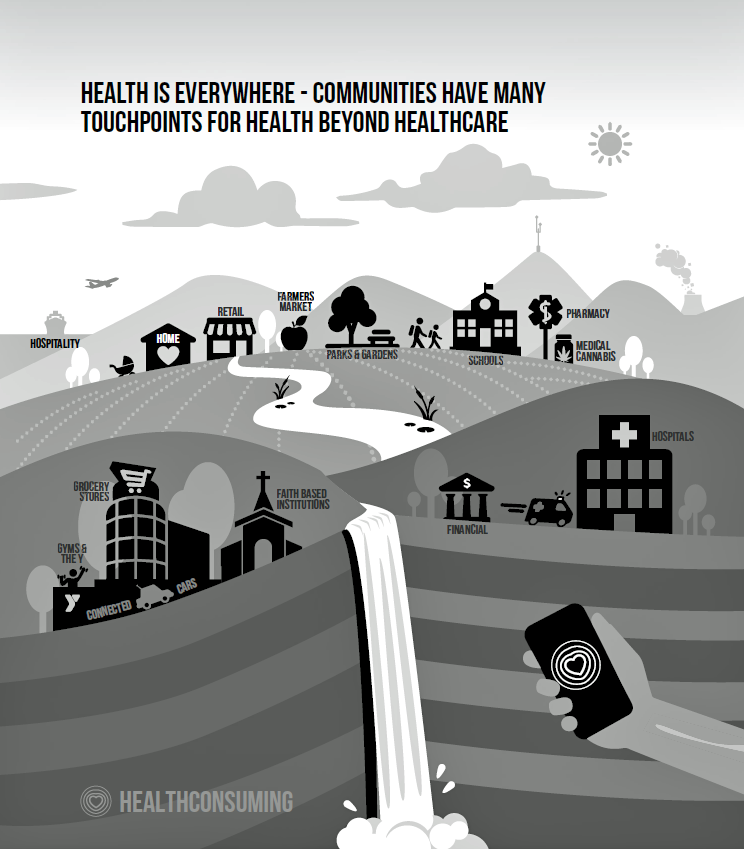
In 2019, I published one of the early books on health care consumerism, HealthConsuming, my spidey-senses perceiving an expanding retail health landscape where patients-as-consumers, caregivers, Quantified Self’ers, and wellness aficionados were engaging with a variety of touchpoints based on their personal values and sense of value to co-create personal and family health: in grocery stores, Big Box and discount stores, freestanding clinics, gyms, the YMCA, hospitality and travel, the barbershop and beauty parlor, and so on.
That retail health embrace has mainstreamed, and Circana’s report on The State of Consumer Healthcare demonstrates that new sense of health-agency, empowerment, and confidence.
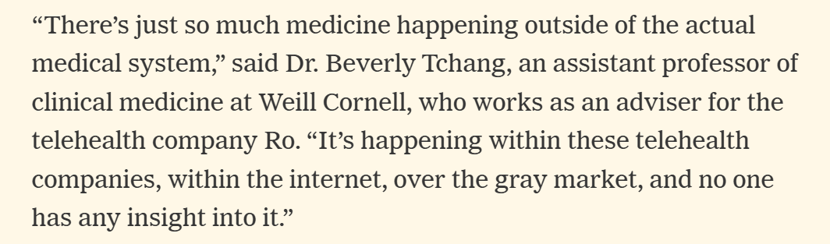
As Dr. Beverly Tchang of Weill Cornell Medical Center, observed, “There’s just so much medicine happening outside of the actual medical system.”
Among the many factors turbocharging this phenomenon has been the millions-person adoption of GLP-1 medicines, from shots to the recent entry of oral medications that have already gotten lots of prescriptions written for users not as keen to self-inject with a fine needle.
Dr. Tchang was quoted in a New York Times long-form essay on “The Great Ozempic Experiment,” published 15th April and written by Julia Belluz who covers health, nutrition, and chronic illness.
The second sentence of Julia’s piece talks about this “new era of D.I.Y. medicine,” adding, “Now the health establishment needs to catch up.”
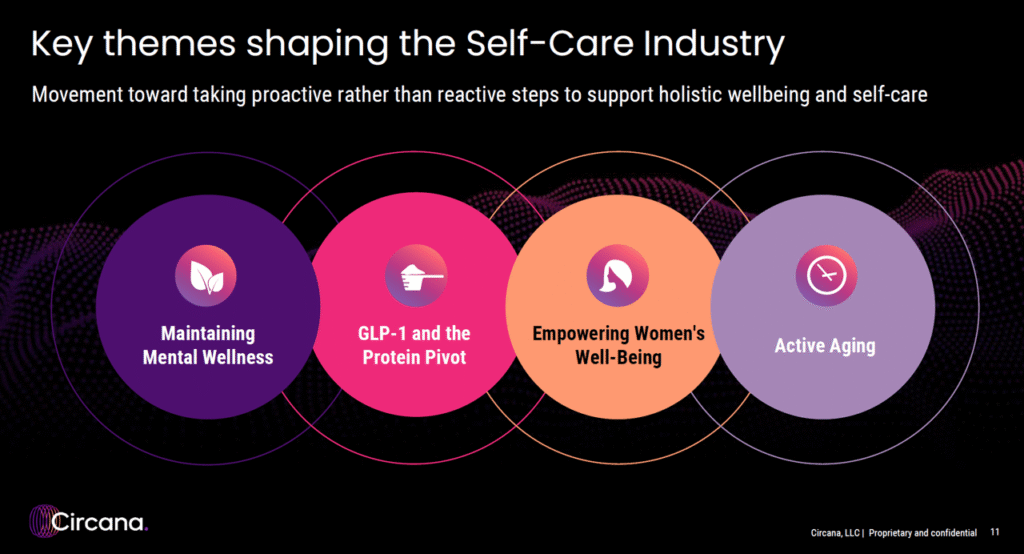
In addition to the GLP-1 medicines and their proliferating forms and doses, Circana also points to three other forces which are converging to bolster consumers’ proactive approaches to wellbeing:
- Mental wellness
- Women’s well-being, and
- Active aging (some referring to “longevity” on this factor).
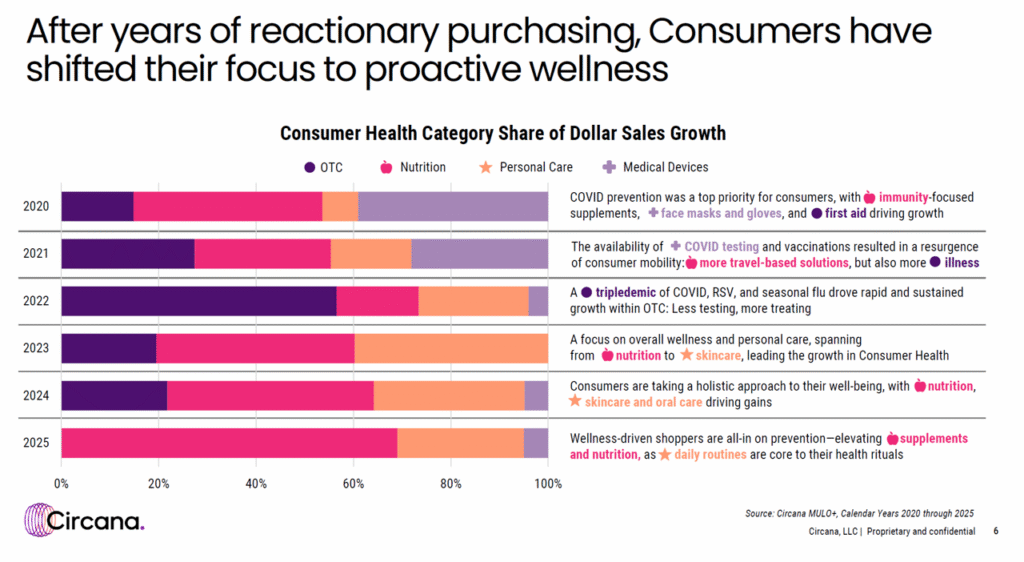
In this tough economic climate with consumers facing inflationary pressures from food to gas tanks, consumer healthcare as a sector is growing faster than retail overall — at 3% dollar and unit sales change in 2025 versus 2% for total retail.
The bar chart illustrates consumers’ shifting spending categories for health, where 2025 saw a big shift toward nutrition, with over-the-counter spending very low (contrasting 2022 where people were self-caring for the “tripledemic” of COVID, RSV, and the flu).
Note that consumer health spending was also focused on value, with people especially opening their wallets for self-care health in Club and eCommerce establishments — up $2 billion and $3 billion, respectively (THINK: Costco, BJs, and Sam’s Club for the former, and Amazon for the latter, as exemplars here).
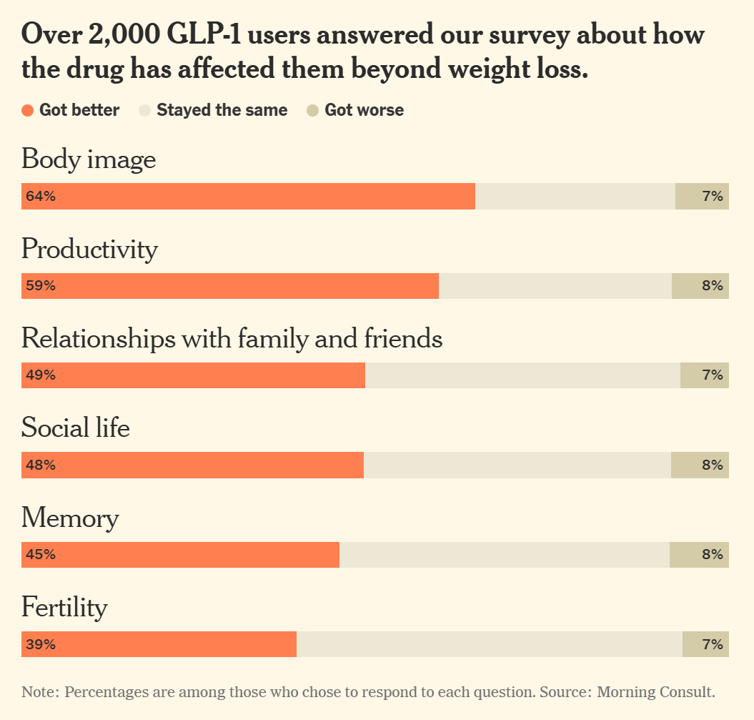
Health Populi’s Hot Points: This bar chart comes from the New York Times piece which included consumer survey research from Morning Consult. The study polled over 2,000 GLP-1 users asking folks how the medicine affected them beyond the core weight-loss objective which inspired them to consume the prescription drug.
Note that most users found several additional benefits beyond losing weight from taking a GLP-1 — like improved perception of body image and feeling more productive.
One-half of GLP-1 consumers said their relationships with family and friends got better, and nearly as many noted an improved social lives and memory.
Factors like body image, social life and relationships all feed into one’s mental health — a key proactive wellness pillar called out by Circana.

In their concluding section discussing The Future of Wellbeing, Circana talks about “owning the self-care narrative:” that enterprises looking to engage people in self-care should assure their offerings serve up holistic approaches across the many lenses on health (mental, physical, appearance, financial) — and that messaging, “celebrates confidence, empowerment, and overall well-being.”
I’ve watched this space and advised on it across the health/care ecosystem for over a decade. What’s quite gratifying at this stage is that people are exercising their consumer muscles, with personal agency and expectations for higher levels of service, personalization, and value.
To repeat Julia Belluz’s call-to-action: “Now the health establishment needs to catch up.”
Or not. Because health-focused consumers are already finding enchantingly-designed, value-based formats and platforms to DIY’ing their wellbeing, physical and fiscal.
The post The New Era of DIY Healthcare – The State of Consumer Healthcare is Buoyant, Empowering, and Holistic, from Head to Gut to Wallet appeared first on HealthPopuli.com.