
HealthPopuli.com – Read More
A commentary in Nature Medicine this week asserts that, “Quality health infomration for all is a fundamental determinant of health.” Lawrence Gostin, a learned health care legal expert at Georgetown, and colleagues, note that, “Society is at a turning point, faced with misleading guidance and ubiquitous, fast-spreading digital and social media…Amplified by generative AI, poor quality information corrodes trust in science and drives social and political polarization.”
With the context in mind that health information is a social determinant of health, we turn to a report from the Pew Research Group which asks and answers the question, Where do Americans get health information, and what do they trust?
The top-line answer: with fast-proliferating digital on-ramps to health information, it is health care providers who are most highly-valued and -trusted at the other side of the search. 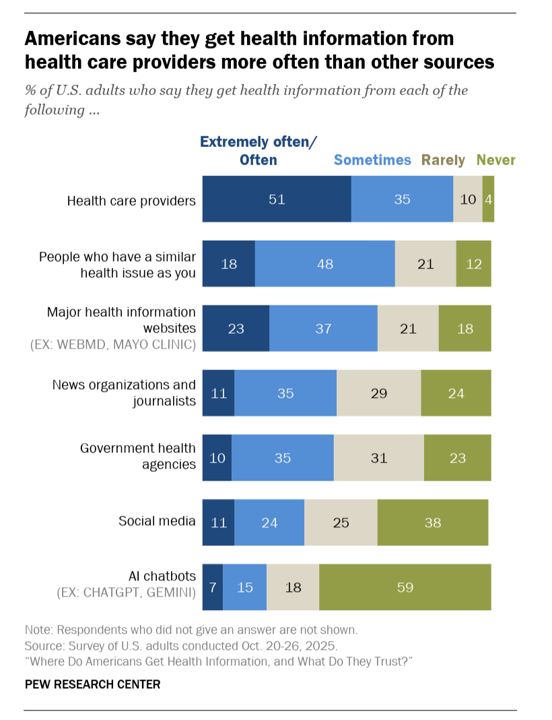
Below receiving health information from health care providers, on a net basis of where Americans get health information “sometimes” or “extremely/often,” roughly equal proportions of seekers look to people who share a similar health issue along with exploring major health information websites, such as WebMD and the Mayo Clinic portal.
Sourcing health information from media and government health agencies garners fewer takers, with social media attracting about one-third of health information seekers and AI chatbots (e.g., ChatGPT or Gemini, among others) attracting 35% and 22%, respectively.
As of late October 2025, when the Pew Research Group fielded this survey, 3 in 5 Americans had “never” accessed an AI chatbot for health information. As five months have passed since these interviews were conducted, it is likely that AI chatbot number has moved higher based on other studies I’ve reviewed here in Health Populi.
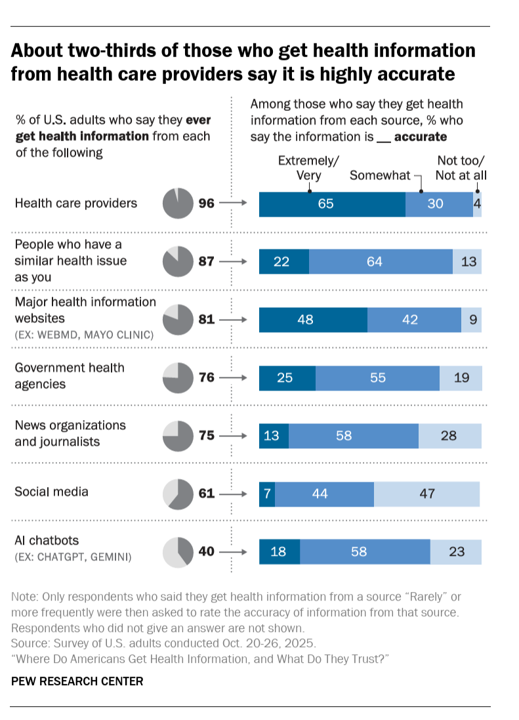
Trust is key to peoples’ health engagement and empowerment, so this graph from PRG’s report has important insights to learn from. As nearly all Americans ever get health information from their providers, we see that two-thirds of these consumers believe the information in extremely or very accurate.
Contrast this to the next-most popular source of health information, people sharing a similar health condition, only 22% of such consumer-health info seekers say are extremely or very accurate.
When it comes to the WebMD’s and Mayo Clinic-type sites — the major health information websites — twice as many health information seekers find these sites extremely or very accurate.
Only one in four health information seekers who use government health agency sites say the information has high accuracy. And, only 13% of people using media for health information believe the info is highly accurate.
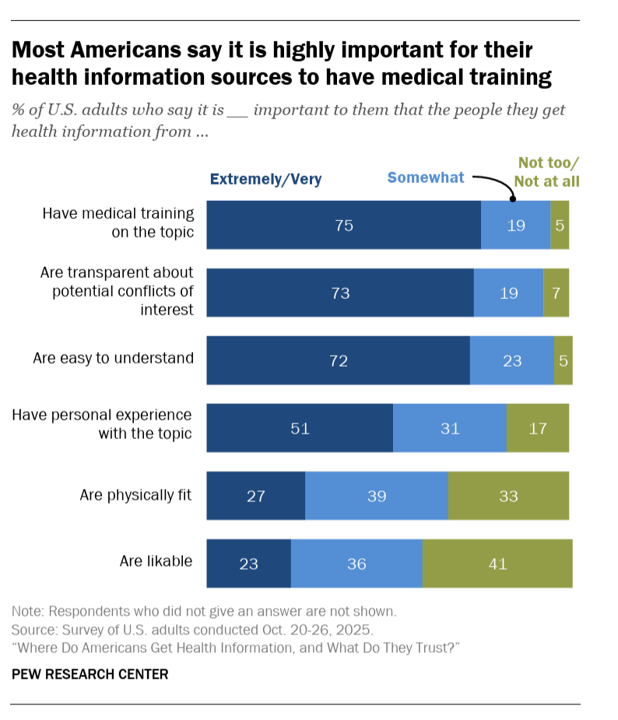
What grants credibility to the health information consumers receive are three factors: that the source:
- Has medical training on the topic,
- Is transparent about conflicts of interest, and,
- Is easy to understand.
Issues such as being “physically fit” or likeability are less important to people seeking credible health information sources.
But one-half of people do believe that a person-source having personal experience with a health issue would be extremely or very important — reflecting back to the 87% of Americans who have ever gotten health information from people who share a similar health issue with them.
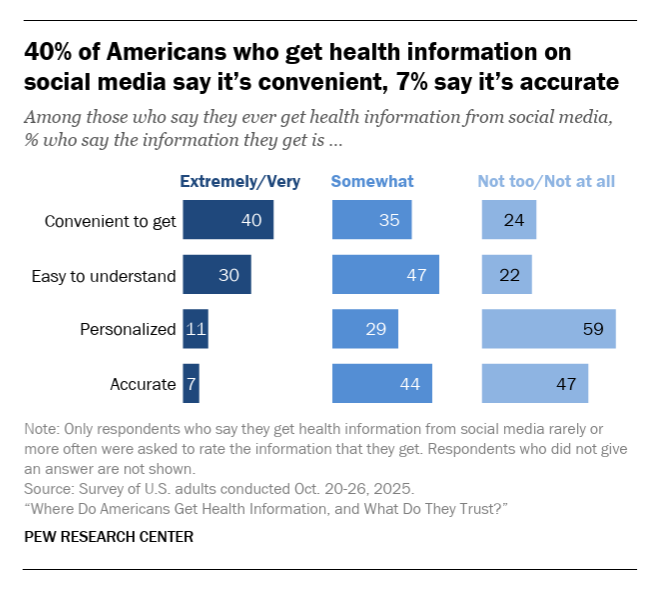
Health Populi’s Hot Points: Convenience in health care is a major factor motivating health consumers’ engagement and sense of agency and experience-delight. We see that social media sources for health information score relatively high on that convenience factor, but low on personalization which is also of high importance to health consumers. In terms of understandability, the consumer-jury is less bullish, with only one-third of people perceiving health information on social media as easy to understand.
As for accuracy? Social media scores low, as well.
For AI chatbot users for health information, convenience also ranks high and understandability better than social media sites do.
As the Pew study suggests, more people in the U.S. are exploring AI-embedded sources for health information, from exploring self-diagnoses to prescription drug access assistance and even to fight medical bills as reported in the New York Times.
A team from Ohio State University’s Wexner Medical Center published research this week indicating that the public’s comfort with AI for health care has fallen. Noting these are early days for AI-based health information seeking, the study reveals some important early-market insights into health consumers’ mindsets and levels of trust in AI for health support. The video here explains some of the findings to keep in mind as we all work toward building well-designed, equitable, trust-working on-ramps for AI in health.
As peoples’ self-care regimes embrace the use of AI-powered search tools, it behooves developers to bring health care providers into the conception and design of the technologies — with patients and caregivers as well. Eroding trust between health citizens vis-a-vis their governments and media gives medical experts a competitive advantage and opportunity to play a key role in the fast-growing portfolio of consumer-facing AI tools. Bringing this shared-decision care team together would bolster doctor-patient relationships along with patients’ agency and digital/health literacy to then optimize individual and community health outcomes.
The post Americans Are Health Information Seekers — Far Above All, Valuing Info from Providers and Medically-Trained Sources (and lessons for AI in health) appeared first on HealthPopuli.com.